
Your TikTok ads are running, orders are coming in - but are you actually profitable? The single number that answers that question is your Customer Acquisition Cost (CAC): how much you spend to win each new customer. Every TikTok seller needs to know this figure before scaling. Use the free calculator below to find yours in under a minute.
TikTok Customer Acquisition Cost (CAC) Calculator
Your average Customer Acquisition Cost is...
Your payback period is months
This tool crunches the numbers instantly. Use it together with the TikTok ads ROI calculator and TikTok ROAS calculator to get a complete picture of your campaign profitability.
How Does the TikTok CAC Calculator Work?
The calculator divides your total marketing spend by the number of new customers you acquired. It breaks expenses into six categories so nothing gets missed:
- Customers Acquired: New customers gained in the period.
- Revenue Per Customer: Average monthly revenue from each new customer.
- Ad Spend: Total spent on TikTok ads.
- Marketing Team Costs: Team headcount multiplied by average salary.
- Software Costs: Monthly fees for tools and analytics platforms.
- Other Costs: Influencer fees, content production, or anything else.
Formula: (Total Marketing Costs ÷ New Customers Acquired) = CAC.
Who Needs This Calculator?
- TikTok Shop Sellers: Track acquisition cost before scaling ad budgets.
- E-Commerce Brands: Compare CAC across channels to see where TikTok sits.
- Affiliate Marketers: Measure cost-effectiveness of TikTok-driven traffic vs. commission earned.
- Small Business Owners: Avoid overspending on ads that don't generate enough return.
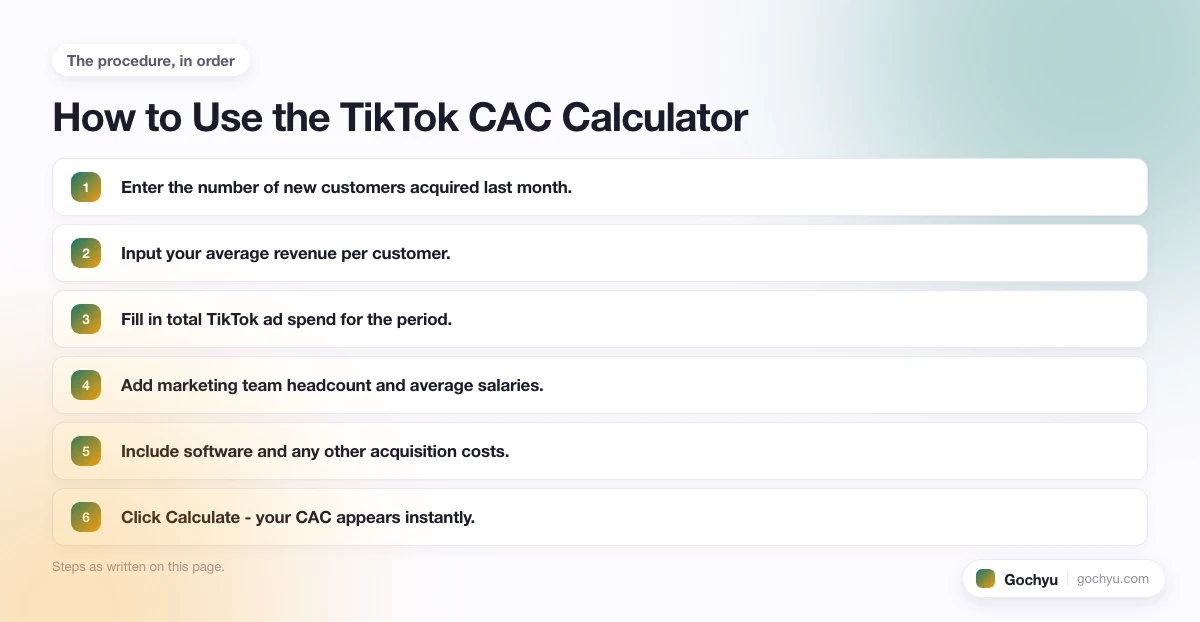
How to Use the TikTok CAC Calculator
- Enter the number of new customers acquired last month.
- Input your average revenue per customer.
- Fill in total TikTok ad spend for the period.
- Add marketing team headcount and average salaries.
- Include software and any other acquisition costs.
- Click Calculate - your CAC appears instantly.
What Is a Good CAC for TikTok?
A healthy CAC depends on your product price and margin, but a common benchmark across e-commerce is a 3:1 LTV-to-CAC ratio - meaning your customer lifetime value should be at least 3x your acquisition cost. For TikTok specifically, average CAC varies widely by niche:
- Impulse-buy products ($20–$50): Target CAC under $15.
- Mid-range products ($50–$150): CAC of $20–$40 is typically sustainable.
- High-ticket items ($150+): CAC up to $80–$100 can work if LTV is strong.
If your CAC is higher than your average order value, you're acquiring customers at a loss. That's only viable if you have strong repeat purchase rates and measurable lifetime value.
Good vs. Bad CAC Results - Examples
3 Examples of Profitable CAC
- 100 customers, $50 revenue each, $3,000 total costs → CAC $30 - earns $20 per customer acquired.
- 200 customers, $40 revenue each, $5,000 total costs → CAC $25 - efficient at scale.
- 50 customers, $100 revenue each, $2,000 total costs → CAC $40 - high-margin, sustainable.
3 Examples of Unprofitable CAC (and Fixes)
- 50 customers, $30 revenue each, $3,000 costs → CAC $60 - Fix: tighten targeting, cut underperforming ad sets.
- 100 customers, $20 revenue each, $2,500 costs → CAC $25 - Fix: bundle products to increase average order value.
- 20 customers, $50 revenue each, $1,500 costs → CAC $75 - Fix: increase ad reach, test new creatives to improve conversion rate.
How to Lower Your TikTok CAC
Once you know your CAC, here are five proven ways to bring it down:
- Improve creative performance: Hook rate and watch-through rate directly affect your CPM and CPC. Test 3–5 creative variations per campaign.
- Retarget warm audiences: Retargeting video viewers and profile visitors typically costs 40–60% less per conversion than cold prospecting.
- Use Spark Ads: Boosting organic content with strong engagement often outperforms traditional video ads at lower CPCs.
- Narrow your audience: Broad targeting works for some products, but testing Custom Audiences built from customer purchase data can cut wasted spend significantly.
- Reduce software and team bloat: CAC includes all marketing costs. Audit your tool stack and eliminate subscriptions that aren't contributing to customer acquisition.
How Often Should You Calculate CAC?
Monthly is the minimum for any active TikTok ad account. Here's a practical cadence:
- Monthly: Compare CAC period-over-period to catch early deterioration before it compounds. If CAC rises 20% in a single month, investigate immediately rather than waiting to see if it corrects.
- After every major campaign change: New creative, new targeting, new product launch - recalculate CAC once you have at least 50 conversions from the change to get a statistically meaningful number.
- Before scaling budget: Never increase ad spend without knowing your current CAC. A profitable CAC at $1,000/month spend can quickly become unprofitable at $10,000/month if your audience saturates or CPMs rise.
- Quarterly for LTV comparison: CAC alone doesn't tell the full story. Every quarter, compare CAC against your updated LTV estimate - the ratio between them determines whether your acquisition economics are improving or worsening over time.
Conclusion: Know Your Number, Scale Confidently
The TikTok CAC Calculator removes the guesswork from your ad spend. Run it monthly, compare periods, and you'll immediately see whether your customer acquisition is trending in the right direction. Pair the results with your LTV data, and you have everything you need to make smart, profitable scaling decisions.
Glossary of Terms
- Customer Acquisition Cost (CAC): Total marketing spend divided by new customers acquired.
- Lifetime Value (LTV): Total revenue a customer generates over their relationship with your brand.
- Revenue Per Customer: Average income generated from each customer in a period.
- Ad Spend: Total amount spent on TikTok advertising.
- Marketing Team Costs: Salaries and direct expenses for your marketing team.
- Software Costs: Monthly fees for analytics, automation, and marketing tools.
* read the rest of the post and open up an offer