
The phrase "TikTok made me buy it" has become one of the most commercially powerful trends in social media history. Since 2020, it has driven billions of dollars in product sales, turned unknown small brands into household names overnight, and created an entirely new form of word-of-mouth marketing built on short video. If you sell products online, understanding this trend is not optional.
This guide covers what the trend is, why it works psychologically, which product categories dominate it, and exactly how sellers can use it to drive real revenue.
What Does "TikTok Made Me Buy It" Mean?
The phrase "TikTok made me buy it" describes the experience of discovering a product through a TikTok video and buying it almost immediately, often without any prior intent to shop. It is a moment of impulsive but satisfying purchase, triggered by seeing a real person demonstrate, review, or rave about a product in a short-form video.
The trend started organically. Users began posting videos showing off things they bought after seeing them go viral on TikTok, using the caption "TikTok made me buy it." The hashtag #TikTokMadeMeBuyIt now has billions of views. It signals to other users: this product is worth your attention, and someone real (not an ad) vouches for it.
What separates it from traditional advertising is the absence of obvious commercial intent. The videos feel like honest recommendations from friends rather than paid placements, even when creators are being compensated. That authenticity gap is exactly why it converts so well.
Why the "TikTok Made Me Buy It" Trend Works
Several psychological and platform factors combine to make this trend unusually effective at driving purchases:
- Authenticity beats polish: Raw, unscripted product videos outperform professionally produced ads on TikTok because viewers are primed to distrust polished content. A creator fumbling with packaging and genuinely reacting to a product is more persuasive than a studio shoot.
- Visual proof at the point of consideration: TikTok is not search. Nobody comes to TikTok planning to buy a waffle maker. But they see one demonstrated in 45 seconds and realise they want it. The video bridges the gap between "never thought about this" and "adding to cart."
- Social proof at scale: Comments like "I just bought this!" and "Adding to cart now!" appear in real time, reinforcing the purchase decision for the next viewer. This chain reaction is almost impossible to manufacture deliberately. It tends to happen when the product genuinely delivers on its promise.
- FOMO (fear of missing out): When something goes viral, there is a real urgency to buy before it sells out. Brands frequently report stock selling out within hours of a video going viral, which further amplifies demand.
- Algorithm reach without followers: TikTok's For You Page can push a video to millions of people regardless of creator follower count. A brand account with 200 followers can go viral on a single product video. That is genuinely unique compared to every other social platform.
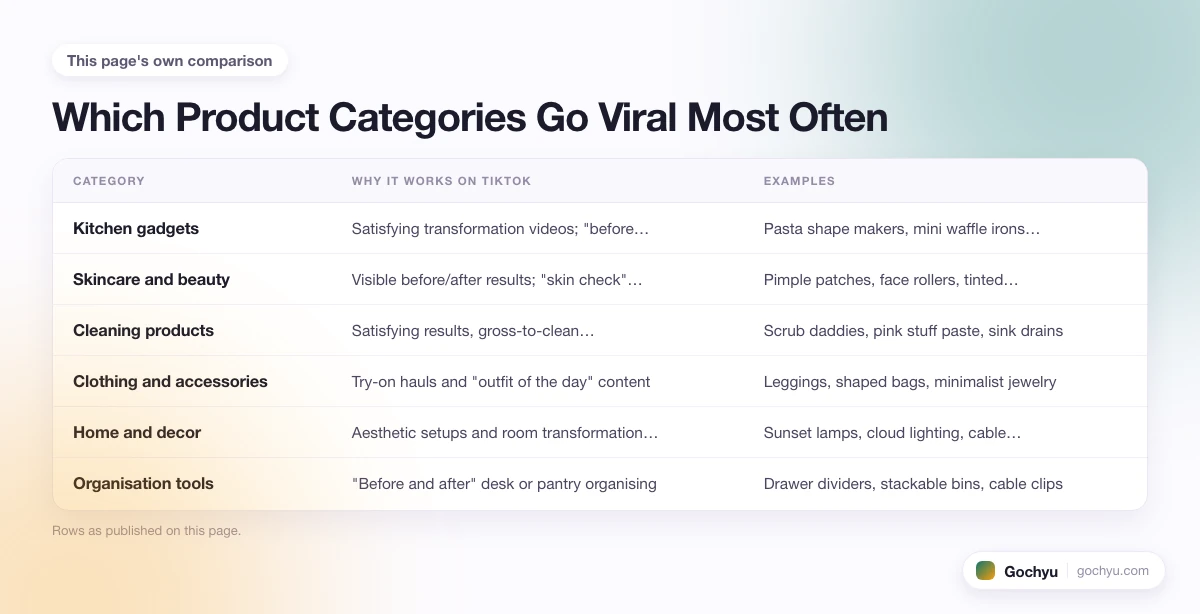
Which Product Categories Go Viral Most Often
Not every product category performs equally well. After analysing thousands of viral "TikTok made me buy it" videos, certain types consistently outperform:
| Category | Why It Works on TikTok | Examples |
|---|---|---|
| Kitchen gadgets | Satisfying transformation videos; "before and after" format | Pasta shape makers, mini waffle irons, butter spreaders |
| Skincare and beauty | Visible before/after results; "skin check" trend | Pimple patches, face rollers, tinted moisturisers |
| Cleaning products | Satisfying results, gross-to-clean transformations | Scrub daddies, pink stuff paste, sink drains |
| Clothing and accessories | Try-on hauls and "outfit of the day" content | Leggings, shaped bags, minimalist jewelry |
| Home and decor | Aesthetic setups and room transformation videos | Sunset lamps, cloud lighting, cable management |
| Organisation tools | "Before and after" desk or pantry organising | Drawer dividers, stackable bins, cable clips |
| Tech accessories | Unboxing and setup demonstrations | Phone stands, cable winders, LED strips |
The common thread: every category above benefits from being shown, not described. If your product is hard to explain but easy to see, TikTok is the right channel.
Real Examples of the Trend Driving Sales
The "Sunset Lamp" became a global bestseller after TikTok users filmed their rooms bathed in warm orange-pink light. The product had existed for years. One relatable video of someone showing their transformed bedroom and it sold out across Amazon within days.
The "TikTok leggings" story is similar. A small brand saw a creator post a try-on video highlighting how the material looked in certain positions. Within 48 hours, the specific leggings were backordered across every retailer. Google search volume for the product spiked 1,000% in a single week.
Scrub Daddy, the cleaning sponge, is a longer-form example. It sold consistently but modestly for years until cleaning content on TikTok went mainstream around 2021. Monthly sales jumped significantly within months, driven almost entirely by user-generated video content. The brand did not pay for this. Their product simply demonstrated well.
None of these were large brands spending heavily on ads. They were products that genuinely worked and could be shown doing so in under 60 seconds.
How Sellers Can Use the "TikTok Made Me Buy It" Trend
If you sell products and want to tap into this trend, the approach is more specific than simply "post on TikTok." Here is what actually works:
Make the Product the Entire Video
Most viral product videos have no presenter on screen. The camera focuses on the product being used. Show it solving a specific, relatable problem. The best format: state the problem in the first 2 seconds, show the product fixing it by second 15, and show the end result by second 30. No introduction, no preamble.
Use User-Generated Content First
Before spending on creator partnerships, send your product to 20-30 people in your existing customer base and ask them to film honest reactions. Some of the most-viewed product videos were made by customers who simply loved a product. Repost the best ones to your brand account with permission. Real customer videos almost always outperform brand-produced content on TikTok.
Partner with Micro-Creators, Not Mega-Influencers
Creators with 10,000 to 100,000 followers in your product's niche convert better than those with millions. Their audiences are tighter and more trusting. A kitchen gadget reviewed by a cooking creator with 40,000 dedicated followers will likely outperform the same product placed with a lifestyle creator at 2 million. Engagement rate matters more than follower count.
Use TikTok Shop for Frictionless Buying
TikTok Shop lets users buy directly from the video without leaving the app. This removes the biggest drop-off point in social commerce: the redirect to an external website. If you are not on TikTok Shop, you are losing a significant percentage of impulse buyers who will not follow a link to complete a purchase.
Use the Right Hashtags
Include #TikTokMadeMeBuyIt and niche-specific hashtags in your video caption. The general hashtag has billions of views and surfaces your video to people actively browsing products in this trend. Add 2-3 niche hashtags (e.g., #kitchengadgets, #cleaningtiktok) to reach audiences interested in your category specifically.
Host Live Shopping Events
TikTok Live shopping sessions let you demonstrate your product in real time, answer questions, and create urgency with limited-time offers. Live shopping converts at higher rates than standard video for certain categories, particularly beauty, skincare, and kitchen products where viewers want to ask questions before buying. See our guide to TikTok Live for businesses for setup details.
What Makes a Product "TikTok Ready"
Not every product is a natural fit for this trend. Before investing time in TikTok content, run your product through this checklist:
- Can it be shown in under 60 seconds? If explaining how it works requires 3 minutes, it is a poor fit for short-form video.
- Does it solve a visible problem? Products that fix something viewers can see (a messy drawer, a skincare concern, a cooking frustration) convert better than those solving invisible problems.
- Is the result surprising or satisfying? Products with an unexpected result, a satisfying sound, or a before/after contrast are far more shareable.
- Is it priced for impulse buying? Products under $50 convert much better from viral TikTok content. Above $100, buyers typically need more research before committing.
- Can you fulfil sudden high demand? If your product goes viral, you need inventory ready. Selling out quickly creates urgency; being out of stock for weeks loses the moment permanently.
The "TikTok Made Me Buy It" Trend for Sellers: Bottom Line
The "TikTok made me buy it" trend is not a marketing strategy you can manufacture. It is a result of having a product that genuinely works and can be demonstrated visually in a short video. What you can do is position your product to benefit when that moment happens: use TikTok Shop for direct purchasing, build relationships with micro-creators in your niche, and seed your product with real customers who will share honest reactions.
The brands that consistently appear in this trend are not spending the most on ads. They are selling products that demonstrate well on video, at prices that trigger impulse purchases, with enough inventory to capitalise on viral moments. If your product fits that profile, TikTok is where buyers are making decisions right now.
For a complete look at selling on TikTok, see our guide to TikTok Shop explained.
* read the rest of the post and open up an offer