
Adding a link to a Shopify collection connects customers directly to a curated group of products. You can add these links through the navigation menu, the Online Store Editor, inside pages and blog posts, as buttons, or from product pages. This guide covers every method with exact steps for each.
How Do You Add a Collection Link to Your Shopify Navigation Menu?
The navigation menu is the most impactful place to link to collections. Changes apply site-wide, so every page shows the updated menu immediately after saving.
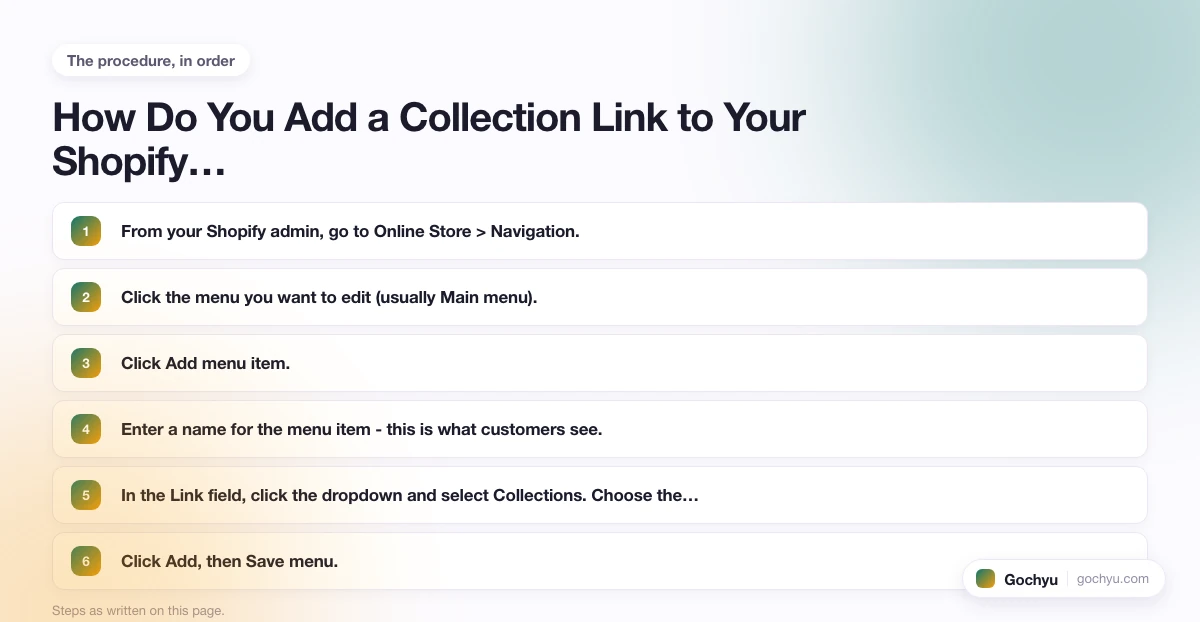
- From your Shopify admin, go to Online Store > Navigation.
- Click the menu you want to edit (usually Main menu).
- Click Add menu item.
- Enter a name for the menu item - this is what customers see.
- In the Link field, click the dropdown and select Collections. Choose the specific collection from the list.
- Click Add, then Save menu.
The collection link appears in your store's navigation bar immediately. You can drag menu items to reorder them, and nest items under a parent to create dropdown submenus (for example, a "Shop" parent item with individual collection links nested inside).
What's the Difference Between Automated and Manual Collections?
When you select a collection to link to, you will find two types in your Shopify admin:
- Automated collections add and remove products automatically based on conditions you set (products tagged "summer," priced under $50, etc.). These update in real time and work well for large catalogs or seasonal promotions.
- Manual collections only include products you specifically add. They give you precise control over what appears, which is useful for curated product sets, gift guides, or bundles. The trade-off is that you need to update them yourself as inventory changes.
For navigation menu links, both collection types work the same way. The type determines how the collection's contents update, not how it is linked to.
How Do You Add a Collection Link Using the Shopify Online Store Editor?
Shopify's Online Store Editor (available in all OS2 themes like Dawn, Sense, and Craft) lets you add collection links as section blocks without writing code. This is the recommended method if you want a collection to appear as a featured section on your homepage or any page that uses the editor.
- In your Shopify admin, go to Online Store > Themes and click Customize.
- Navigate to the page where you want to add the collection link (homepage, a landing page, etc.).
- Click Add section and choose a section type that supports collection links - for example, "Featured collection," "Collection list," or a button block.
- In the section settings panel on the right, click the Collection field and select the collection you want to link to.
- For a button link specifically: add a Button block within any section, set the button label, and in the Link field select the collection.
- Click Save.
The Online Store Editor renders the link live as you build, so you can see exactly how it appears before saving. This method gives you full control over design (image, heading, button style) without touching any theme code.
How Do You Add a Collection Link Inside a Page or Blog Post?
To link to a collection from within body text in a page or blog post, use the rich text editor:
- Go to the page or blog post you want to edit in your Shopify admin.
- Highlight the text you want to turn into a link.
- Click the link icon in the editor toolbar.
- In the URL field, type or paste the collection's path. You can find this by opening the collection in your storefront and copying the URL - it will look like /collections/your-collection-name. Use the relative path (without the full domain) to keep links portable across environments.
- Click Insert link, then Save.
For a button link inside a page, use Shopify's section editor in the theme customizer rather than the rich text editor - the theme customizer lets you add styled button blocks with collection links that match your store's design system.
How Do You Link to a Collection from a Shopify Product Page?
Linking from a product page back to its parent collection keeps customers browsing within a category instead of leaving the site. Most Shopify OS2 themes include a breadcrumb trail automatically, which shows the collection the product belongs to as a clickable link. To check or enable this:
- Go to Online Store > Themes > Customize.
- Navigate to a product page in the editor.
- Look for a Breadcrumbs toggle in the product template settings. If the theme supports it, turn it on.
- The breadcrumb displays as: Home > Collection Name > Product Name, with the collection name linking back to the collection page.
For themes without built-in breadcrumbs, you can add a "Back to [Collection]" button using a product page block in the editor, or link to the collection in the product description text using the rich text editor method described above.
How Do You Add Collection Links Using the Shopify Mobile App?
The Shopify app for iOS and Android supports navigation editing. Open the app, tap Online Store, then Navigation. Tap the menu to edit, add a new menu item, and select Collections as the link type. Changes save and apply to your live store immediately - useful for quick updates when you are away from a desktop.
How Do You Track Which Collection Links Are Driving Traffic?
Adding collection links is only half the job. Knowing which ones customers actually use helps you prioritize navigation structure and merchandising decisions.
In Shopify Analytics, go to Analytics > Sessions by location or use the Navigation summary report if your theme supports it. You can see which pages customers land on and what they click next. For more granular data, use UTM parameters on collection links you share externally (in emails, social media, ads) so Google Analytics or Shopify Attribution captures the source.
For internal navigation links (inside the store), Shopify's Online Store Editor shows click data per section in some themes. Google Analytics 4's click tracking (via event data) tells you exactly which links customers interact with on any given page, including collection links in your navigation menu and in-page sections. Set up a GA4 property and connect it via the Shopify Google & YouTube channel if you want this level of detail. Even basic reporting tells you quickly if a collection you linked in the main nav is getting zero clicks - a signal to revisit the naming or placement.
How Do You Test Collection Links After Adding Them?
After saving any collection link, test it on both desktop and mobile before driving traffic to the page. In your Shopify admin, click Online Store > Open preview to view your store as a customer. Click every collection link you have added and verify it loads the correct collection page. Then open the store on a phone - mobile rendering can differ from desktop, and a link that works on desktop sometimes fails on mobile themes.
If a link leads to a 404 page, the most common causes are:
- The collection was deleted or the slug was changed after the link was created
- A typo in a manually entered URL path
- The collection is set to "Draft" status and is not yet published
Shopify does not auto-update navigation or page links when a collection is renamed or deleted. You need to update those links manually. Run a full navigation audit after any large catalog restructure.
Conclusion: Adding Links to Shopify Collections
For most stores, the navigation menu is the right starting point for collection links - it reaches every page in your store at once. From there, the Online Store Editor gives you design-controlled link blocks on specific pages, while the rich text editor handles contextual links inside blog posts and page content. Product page breadcrumbs tie the catalog structure together by linking products back to their parent collections. Always test after making changes, and audit your navigation whenever you restructure your collections.
For more on Shopify store setup, see our guide on adding filters to your Shopify store to help customers narrow down collections once they arrive.
* read the rest of the post and open up an offer