To run auctions on Shopify, you need a third-party auction app since Shopify doesn't include auction functionality natively. Install an app like Webkul Product Auction or Tipo Product Auction, configure your bidding rules (start price, bid increment, reserve price), assign the auction to a product, and publish. The whole setup takes under 30 minutes.
Select the Perfect Auction App
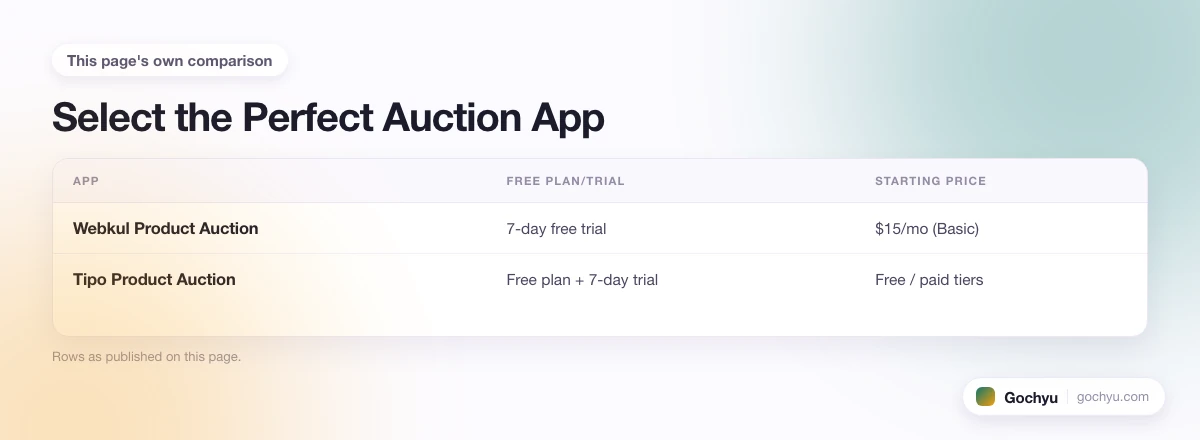
To run auctions on your Shopify store, you'll need a dedicated auction app. Two top contenders are Webkul Product Auction and Tipo Product Auction. Both offer strong features to customize your auctions, from setting bid increments and reserve prices to enabling proxy and popcorn bidding.
| App | Free Plan/Trial | Starting Price | Best For | Key Features |
|---|---|---|---|---|
| Webkul Product Auction | 7-day free trial | $15/mo (Basic) | High-volume sellers, unlimited auctions | Proxy bidding, popcorn bidding, joining fees, multiple winners |
| Tipo Product Auction | Free plan + 7-day trial | Free / paid tiers | New sellers testing auctions | Custom bid increments, reserve prices, buyout price, email notifications |
- Offers a 7-day free trial and unlimited auctions.
- Supports proxy bidding, popcorn bidding, joining fees, and multiple winners.
- Real-time product page updates based on bids.
- Subscription cost: Basic plan for $15/month, Executive plan for $30/month, and Pro plan for $40/month.
- Provides a free plan and 7-day free trial.
- Allows customizing bid increments, reserve prices, and buyout prices.
- Sends email notifications for new bids and auction winners.
- User-friendly interface for quick auction setup.
How to Choose the Right Shopify Auction App for Your Store
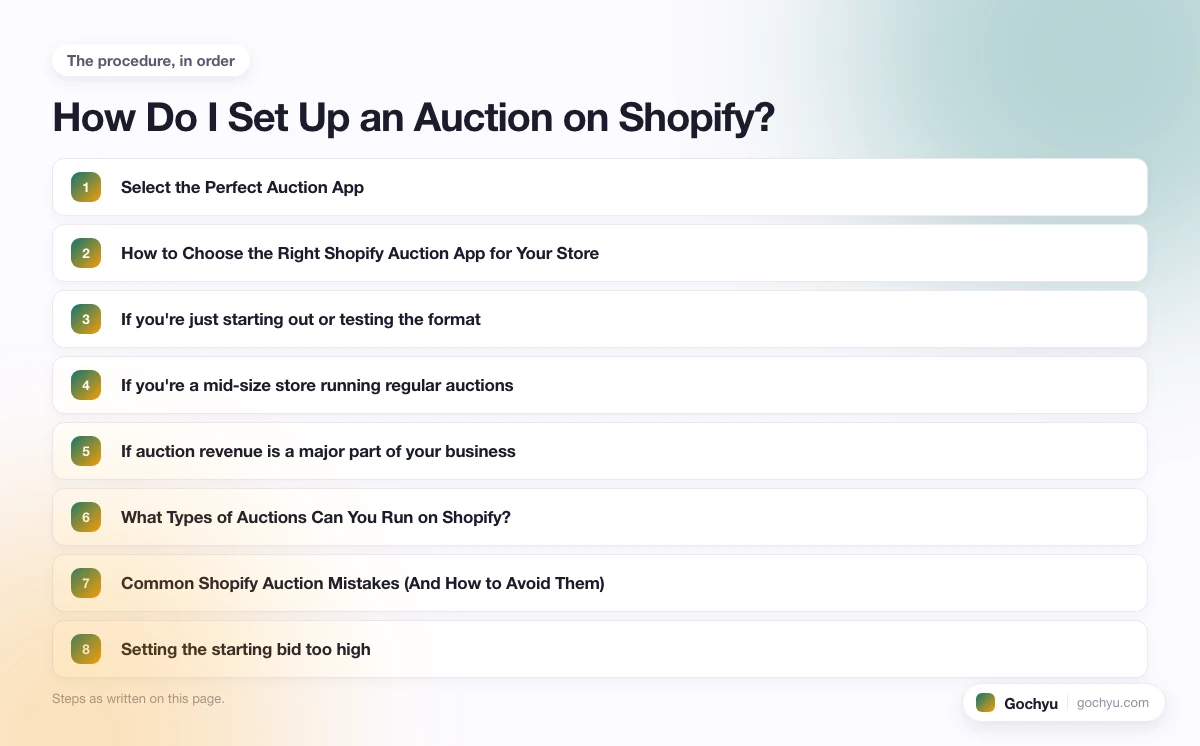
The right auction app depends on three factors: your store size, how many auctions you plan to run, and your monthly budget. Here's a practical decision framework rather than a feature checklist.
If you're just starting out or testing the format
Start with Tipo's free plan. It supports basic auctions with custom bid increments and email notifications at no cost. You can run a few auctions, see how your audience responds, and decide whether the format is worth investing in before spending anything. If you run fewer than five auctions per month and don't need proxy bidding or advanced automation, Tipo's free tier covers everything you need.
If you're a mid-size store running regular auctions
Webkul's Basic plan ($15/month) is the better fit once auctions become a consistent sales channel. The jump in value comes from unlimited auctions (Tipo's paid tiers cap this), proxy bidding (which lets serious buyers set a maximum and let the system bid for them automatically), and the joining fee feature (which filters out low-intent bidders). Stores running weekly auctions on popular or limited items will recover the monthly fee quickly from a single auction.
If auction revenue is a major part of your business
Consider Webkul's Executive ($30/month) or Pro ($40/month) plans. These add features like multiple winners per auction (useful for selling identical items to several top bidders simultaneously), advanced analytics, and priority support. At this scale, losing one auction to a technical issue costs more than the plan upgrade.
One factor most guides skip: customer support response time. Auction issues (a bidder can't check out, the timer froze, a bid wasn't registered) happen in real time and need fast resolution. Before committing to either app, test their support with a pre-sales question and note how quickly they respond.
What Types of Auctions Can You Run on Shopify?
Both Webkul and Tipo support multiple auction formats, letting you match the auction type to your product and audience:
- English auction (ascending bid): The classic format. Bidders compete by raising each other's bids. The highest bid when the timer expires wins. Best for desirable items where competition will push the price up, such as collectibles, limited editions, and handmade goods. This format generates the most excitement and the highest final prices when there's genuine demand.
- Dutch auction (descending price): The price starts high and drops at set intervals until a buyer claims the item. Useful for moving inventory quickly or selling multiple identical units. A good example: you have 20 units of a discontinued item and want to clear them at the best possible price without a standard flash sale.
- Silent auction: Bidders submit sealed bids without seeing what others are offering. The highest bid at closing wins. Common for charity events or when you want to avoid visible bidding wars that might discourage lower-budget buyers from participating at all.
- Reserve price auction: Sets a minimum hidden price so the auction only completes if bids reach the reserve. This protects your margin while still creating the urgency of an auction format. If bids don't reach the reserve, you can close the auction without selling at a loss, which feels much cleaner to buyers than a cancellation.
- Buyout price: Lets shoppers skip the auction entirely and purchase immediately at a fixed price. This converts impatient buyers while the auction runs for everyone else. Works particularly well on items where some buyers are willing to pay a premium to guarantee they win rather than risk losing to a last-second bid.
Common Shopify Auction Mistakes (And How to Avoid Them)
Most failed Shopify auctions trace back to the same handful of avoidable errors. Here's what goes wrong and how to prevent it.
Setting the starting bid too high
A high starting bid kills momentum before the auction starts. When no one bids in the first few hours, the listing looks unpopular and later visitors scroll past it. Set your starting bid at a price you'd be comfortable accepting, not the price you're hoping to get. A low opening bid attracts early bidders, and early bidding activity signals to other shoppers that this item is worth competing for. The final price is set by competition, not the opening number.
Skipping the reserve price
Running an auction without a reserve price on a valuable item is risky. If your starting bid is $1 and only one person bids, you're committed to selling at $1. Use a reserve price any time you have a floor below which selling makes no financial sense. Set it at your actual minimum acceptable price, not your dream price. The auction can close without a winner if the reserve isn't met, and that's far better than a forced sale at a loss.
Choosing the wrong auction duration
A 24-hour auction launched on a Tuesday afternoon will close Wednesday afternoon with minimal traffic. A 7-day auction on a low-demand item gives people too long to procrastinate and then forget. As a starting point: 3 to 5 days works well for most items, ending on a weekend evening when your audience is most likely to be online and willing to snipe a last-minute bid. Test different durations and track which end times generate the most bid activity in the final hour.
Not telling your existing customers the auction is live
The biggest audience you already have is your email list and social followers. Many sellers set up an auction and wait for organic traffic, then wonder why they got three bids. Send an email before the auction opens, another when it goes live, and a final "ending soon" reminder 2 to 4 hours before close. Existing customers already trust your store, which makes them far more likely to bid than cold traffic.
No clear end time displayed on the product page
Ambiguity kills urgency. If a visitor sees "auction ending soon" without a specific countdown, they may plan to come back later and forget entirely. Make sure your auction app is displaying a live countdown timer directly on the product page. Both Webkul and Tipo include countdown widgets, but confirm this is enabled in your settings before going live.
Configure Your Auction Settings
Once you've installed your chosen app, it's time to set up your first auction. Follow these steps to get started:
- Select the product you want to auction.
- Enable the auction feature and set the details:
- Base price and reserve price.
- Bidding increments and rules.
- Start and end dates/times.
- Proxy bidding, popcorn bidding, and joining fee options (if applicable).
- Customize the auction page design to match your branding.
- Preview your auction and make any final tweaks.
Listing Products for Auction
With the auction app installed and configured, it's time to list your products for auction. Proper listing attracts more bidders and higher final bids.
- Select Products: Choose the products from your Shopify inventory that you want to auction.
- Create Auction Listings: Use the auction app to create a new auction for each product.
- Enter Product Details: Fill in the necessary details like product description, images, and any specific auction rules.
- Set Pricing and Duration: Determine the starting price, bid increments, and how long the auction will last.
- Publish and Promote: Publish the auction and use your marketing channels to promote it to potential bidders.
What Products Work Best for Shopify Auctions?
Not every product is well-suited for an auction format. Auctions work best when there's genuine perceived scarcity or collector interest, when multiple buyers want the same item and are willing to compete for it.
- Limited edition or numbered items: The finite quantity creates inherent scarcity. A numbered print, a limited-run colorway, or a season-end product all signal that bidding is the only way to secure the item.
- Handmade or one-of-a-kind goods: No two items are identical, so each auction is inherently unique. Jewelry, art, custom furniture, and ceramics perform well in this format.
- Collectibles and vintage items: The resale value and nostalgia factor make bidders willing to pay above retail. Vintage clothing, sports memorabilia, and retro electronics attract competitive bidding.
- Overstock and end-of-season inventory: Auctions move slow-selling stock faster than discounting, without permanently training customers to wait for sales. A starting bid of $1 creates buzz even if the final price is modest.
- Charity items: Auction formats are natural for fundraiser sales. Set a portion of proceeds to a cause and the emotional engagement drives bids higher than standard pricing would.
Managing and Monitoring Auctions
Effective management and monitoring are important for the success of your auctions. This ensures a fair bidding process and lets you respond to any issues quickly.
- Monitor Auctions: Keep an eye on active auctions through the auction app's dashboard.
- Engage with Bidders: Provide updates and answer any questions from potential bidders.
- Review Bids: Regularly check the bids to ensure there are no issues or discrepancies.
- Finalize the Auction: Once the auction ends, notify the winning bidder, arrange for payment, and handle the shipping process.
How to Promote Your Shopify Auction
An auction with no audience gets no bids. Promotion is the difference between a bidding war and a flat close.
- Email your list before the auction opens: Send a "coming soon" announcement 48 hours before launch, then a "bidding is live" email when it starts. Urgency-focused subject lines ("Only 24 hours left") drive opens and clicks.
- Post a countdown on social media: Share the auction start date as a countdown on Instagram Stories or TikTok. Show the item, explain what makes it special, and give a direct link. Remind your audience 1 hour before close.
- Create exclusivity messaging: "Only 1 available. Bidding ends Friday at midnight." Frame the auction as a rare opportunity, not just a discount. Buyers who miss this one should feel they missed something real.
- Add a "Bidding Now" banner to your storefront: Most auction apps let you display a badge or widget on your homepage. Returning customers who didn't know the auction was live will discover it organically.
- Follow up with non-winners: If 10 people bid on one item and 9 lose, those 9 are warm leads. Webkul allows automatic follow-up emails to outbid participants, so you can offer them a similar item or alert them to the next auction.
For a deeper look, see our complete guide to Shopify Apps For Your Store.
Conclusion: How to Set Up an Auction on Shopify
Setting up an auction on Shopify takes three steps: install a Shopify auction app (Webkul or Tipo), configure your bidding rules, and assign the auction to a product. The technical setup is straightforward. The harder part is choosing the right product, picking the right app for your store size, and promoting the auction aggressively enough to generate competitive bidding. Start with a single limited-edition or overstock item, run it as a test, and measure how bid volume responds to your promotion channels before scaling to regular auctions.
* read the rest of the post and open up an offer