
Most people searching "TikTok porn ads" are users who have seen sexual or adult-adjacent ads appear in their TikTok feed and want to know why. The short answer: TikTok does not allow pornographic ads, but its ad targeting system and occasional policy lapses can cause suggestive or borderline content to surface. This page explains why it happens and how to stop seeing those ads.
Does TikTok Allow Porn or Adult Ads?
No. TikTok's advertising policies explicitly prohibit sexually explicit content, nudity, and pornographic material. This applies to all ad formats: in-feed ads, TopView, Spark Ads, and branded content. TikTok uses both automated moderation and human review to screen ads before they run, and violations result in immediate rejection.
The platform's strict stance exists for several reasons:
- A significant portion of TikTok's audience is under 18, requiring a family-safe advertising environment
- Brand safety: major advertisers won't spend on platforms associated with adult content
- Regulatory pressure in multiple markets (US, EU, UK) around child protection online
Why Am I Seeing Adult or Sexual Ads on TikTok?
If you're seeing ads that feel sexual, suggestive, or inappropriate, there are a few likely explanations:
- Suggestive-but-allowed content: TikTok permits ads for lingerie, dating apps, adult relationship platforms, and similar products as long as they don't show explicit material. These ads can feel jarring even when they technically comply with policy.
- Age-gated ads reaching wrong audiences: Advertisers use TikTok's age-targeting tools to restrict adult-adjacent ads to users 18+. When these tools are misconfigured, or when a minor has entered a false birth date, the targeting breaks down.
- Policy enforcement lag: Ads are sometimes approved incorrectly and run briefly before being caught. TikTok processes millions of ads; occasional errors slip through and may appear in your feed before being removed.
- Interest-based targeting: If TikTok's algorithm has categorized you as interested in topics adjacent to adult content (fitness, relationships, fashion), advertisers targeting those interest segments may show ads you find inappropriate even if they aren't explicitly sexual.
- Regional policy differences: Advertising standards vary by country. An ad approved in one region may be subject to stricter rules in another. Cross-border targeting errors can occasionally cause content that meets one country's standard to appear to users in another where the same content would be rejected.
Why Is Explicit Content Appearing in My Regular TikTok Feed (Not an Ad)?
If the content you are seeing looks like explicit organic video rather than a paid advertisement, you are dealing with a different problem. TikTok's content moderation system uses both automated filters and human review, but the sheer volume of content uploaded every minute means explicit videos occasionally surface in feeds before being caught and removed.
Several factors explain why explicit organic content reaches a regular TikTok feed:
- Content moderation lag: TikTok processes millions of videos per day. A video can be uploaded, start receiving views through the For You algorithm, and reach thousands of feeds before a moderation review flags it for removal. That window can range from minutes to several hours.
- Algorithm misclassification: TikTok's recommendation system classifies content based on signals like hashtags, captions, audio, and watch behavior. Content with suggestive audio or captions can be misread as appropriate and pushed to a broader audience before manual review corrects the mistake.
- Accounts using gray-area tactics: Some creators post videos that stay within TikTok's on-screen guidelines but use their bio link to send viewers to adult platforms elsewhere. The TikTok video itself passes moderation, but the account is designed to funnel traffic off-platform. These accounts can stay active for a long time before TikTok closes them.
- Regional content differences: Accounts based in countries with different local moderation thresholds sometimes produce content that gets surfaced globally through TikTok's algorithm before regional content policies override it.
- Restricted Mode limitations: Even with Restricted Mode enabled, TikTok cannot catch every video before it reaches your feed. Restricted Mode filters content categories but is not a real-time guarantee against any specific video slipping through.
If you see explicit organic content (not an ad), report it directly: long-press the video, tap the share arrow, select "Report," and choose "Adult nudity and sexual activities." This sends it to human review faster than any automated filter. TikTok's algorithm also uses your reports as a negative signal, which reduces the chance of similar content appearing again.
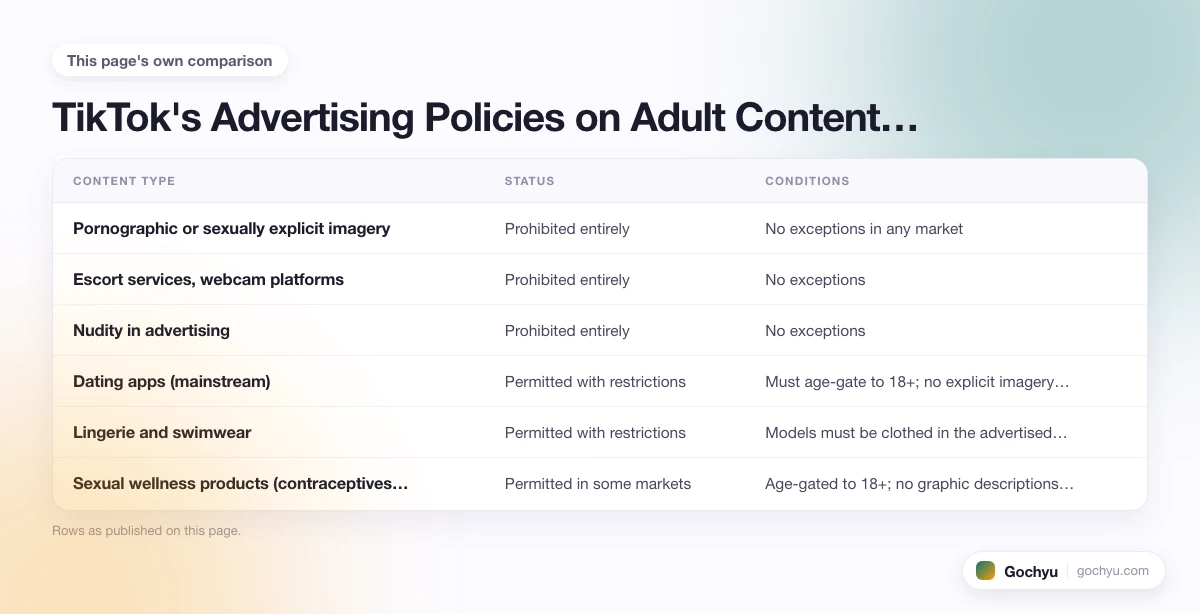
TikTok's Advertising Policies on Adult Content: Prohibited vs. Allowed
Understanding exactly where TikTok draws the line helps explain what you're seeing in your feed. The distinction between "prohibited" and "permitted with restrictions" is where most confusion comes from:
| Content Type | Status | Conditions |
|---|---|---|
| Pornographic or sexually explicit imagery | Prohibited entirely | No exceptions in any market |
| Escort services, webcam platforms | Prohibited entirely | No exceptions |
| Nudity in advertising | Prohibited entirely | No exceptions |
| Dating apps (mainstream) | Permitted with restrictions | Must age-gate to 18+; no explicit imagery; no suggestive language about hookups |
| Lingerie and swimwear | Permitted with restrictions | Models must be clothed in the advertised product; no explicit poses |
| Sexual wellness products (contraceptives, personal care) | Permitted in some markets | Age-gated to 18+; no graphic descriptions or demonstrations; market-dependent |
| Adult relationship platforms | Permitted with restrictions | Restricted targeting to 18+; no explicit content; limited markets |
The gray area is the "permitted with restrictions" category. These ads are technically compliant, but they can still feel inappropriate to users who weren't expecting adult-adjacent advertising in their feed.
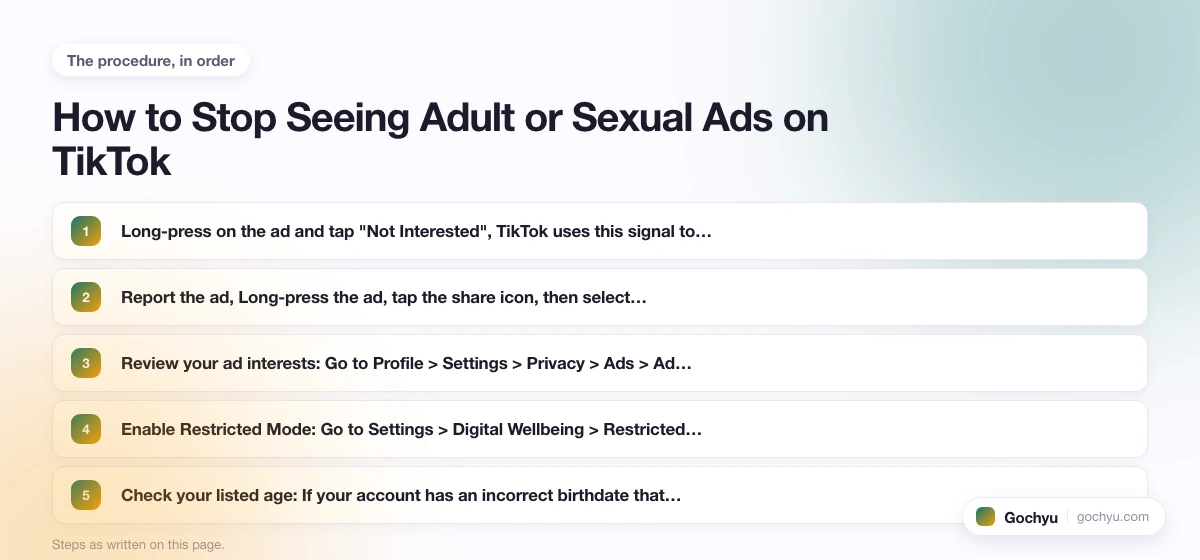
How to Stop Seeing Adult or Sexual Ads on TikTok
TikTok gives you several tools to reduce or eliminate ads you find inappropriate:
- Long-press on the ad and tap "Not Interested", TikTok uses this signal to adjust your ad profile. Doing this consistently for similar ads teaches the algorithm to stop serving that category.
- Report the ad, Long-press the ad, tap the share icon, then select "Report." Choose "Inappropriate content" or "Adult/sexual content." Reported ads are reviewed by TikTok's moderation team. If the ad violates policy, it is removed and the advertiser penalized.
- Review your ad interests: Go to Profile > Settings > Privacy > Ads > Ad Interests. Remove any interest categories that are pulling in unwanted ad types (relationship, dating, adult wellness).
- Enable Restricted Mode: Go to Settings > Digital Wellbeing > Restricted Mode. This filters out content TikTok classifies as mature, including some ad categories, though it is not 100% comprehensive.
- Check your listed age: If your account has an incorrect birthdate that lists you as an adult, update it. Go to Profile > Edit Profile > Birthday. Users listed as 13-15 have the most restrictive ad filtering; 16-17 have additional filters above the adult baseline.
How Advertisers Attempt to Get Around TikTok's Adult Content Rules
Not every suggestive ad you see is there by accident. Some advertisers deliberately push TikTok's content guidelines to gain attention while staying just inside the line. Common tactics include:
- Misleading thumbnail images: An advertiser creates an ad where the first frame is provocative but within guidelines, knowing the hook will capture attention before the viewer realizes it's an ad for something mundane. This is a known tactic for driving engagement metrics.
- Broad interest targeting: Advertisers for adult-adjacent products (dating apps, lingerie, wellness) often use broad audience targeting rather than precise age or interest filters. This results in their age-gated content reaching users whose profiles aren't clearly in the 18+ category.
- Split-testing creative: Some advertisers A/B test multiple versions of an ad and submit all of them for review simultaneously. Occasionally, one version that is slightly more suggestive gets approved while the others are rejected, and it runs until TikTok catches it.
When you report these ads, you're contributing to TikTok's enforcement data. The platform uses report volume as a signal to flag advertisers for human review.
What Happens to Advertisers Who Violate TikTok's Adult Content Rules?
TikTok's enforcement against advertisers who break adult content rules operates on a tiered system. The severity of the response depends on whether it's a first offense, a repeat pattern, or an egregious violation.
For a first-time violation, TikTok typically issues a warning and removes the offending ad. The advertiser's account remains active, but a strike is recorded. Repeat violations within the same account trigger ad suspension, where TikTok pauses some or all of the account's active campaigns pending a policy review. Advertisers who continue violating after suspension, or who commit an especially serious violation such as running explicit pornographic content, face a full account ban from TikTok Ads Manager.
Advertisers can appeal any enforcement decision. The appeal process goes through TikTok Ads Manager within 30 days of the violation notice. To have any chance of success, the advertiser must submit a policy-compliant version of the creative and provide a written explanation of how the original ad violated the rules and what changes were made. TikTok does not guarantee reinstatement.
One consequence that surprises many advertisers: TikTok does not refund ad spend for removed ads. If an ad runs for six hours before TikTok catches a violation, the advertiser is billed in full for those six hours of impressions and clicks. There is no clawback mechanism. This means bypassing the rules is not just risky from a policy perspective; it's also a financial gamble where the house always wins.
A banned TikTok Ads Manager account cannot simply open a new one. TikTok fingerprints accounts using a combination of business entity details, domain URLs, and payment methods. An advertiser who tries to re-register using the same business name, website, or credit card will typically find the new account flagged and suspended quickly. This makes evasion genuinely difficult for serious repeat offenders.
From a user perspective, the practical effect of an advertiser ban is immediate: all of that advertiser's ads stop running across every TikTok feed simultaneously. Users who reported those ads won't receive a notification that action was taken, but the ads simply disappear.
The scale of TikTok's enforcement operation is substantial. TikTok's Transparency Center publishes quarterly ad policy enforcement reports, and recent reports show tens of millions of ads removed and hundreds of thousands of advertiser accounts suspended per quarter. The majority of those enforcements target prohibited products broadly, not adult content specifically, but the same enforcement system applies to adult and NSFW ads on TikTok in exactly the same way.
What If You Are an Adult Content Creator?
If you create adult content professionally, TikTok's advertising restrictions don't mean the platform is useless to you. It just means you need to use it differently from how mainstream advertisers operate.
TikTok's organic reach is genuinely unmatched. The strategy that works for adult creators is to build a following through entirely clean, policy-compliant TikTok content, then funnel that audience to monetized platforms elsewhere. TikTok does not police what your linked platform (OnlyFans, Fansly, Patreon, or similar) actually hosts. You can maintain a TikTok presence built around lifestyle, personality, fitness, fashion, cooking, comedy, or behind-the-scenes content that never crosses any policy line, while your bio link directs followers to subscription content on a separate platform. This is fully within TikTok's creator terms, and thousands of creators use this approach successfully.
The content types that work best for adult creators building on TikTok organically include: fitness and workout content, fashion and styling videos, day-in-the-life vlogs, humor and comedy skits, cooking or recipe content, and dancing or trend participation. Anything that showcases personality without triggering content filters builds a loyal audience that then follows you off-platform.
TikTok's creator marketplace is also open to adult creators whose TikTok content itself is clean. If your TikTok profile contains only compliant content, mainstream brands can approach you for sponsored posts. Your content on other platforms is generally not a factor as long as your TikTok itself stays within the rules.
When you do want to run paid advertising for adult content, the specialist networks built for that purpose are a better fit than TikTok. TrafficJunky is the largest adult ad network, operating across major adult sites with programmatic display and pre-roll video; CPMs vary widely but typically run $1-$5 for display and $3-$10 for video depending on geo. ExoClick offers similar reach with strong targeting options and is particularly strong for European traffic. JuicyAds focuses on pop-under and banner formats and is known for lower minimum spend thresholds, making it accessible for smaller budgets. AdultAdWorld specializes in niche audience targeting within the adult category.
The most effective approach combines both channels: use TikTok for top-of-funnel organic audience building (free, high reach, builds brand), then use adult ad networks for conversion-focused paid campaigns targeting people already in the right mindset to subscribe or purchase. The two are complementary, not competing.
For a deeper look, see our complete guide to TikTok for OnlyFans performers.
Is There an 18+ Version of TikTok?
No official 18+ version of TikTok exists. The platform operates under a single set of community guidelines that apply to all users, and those guidelines prohibit sexually explicit content across the board regardless of age.
Some related platforms and apps worth knowing about:
- TikTok Lite: A stripped-down version of TikTok designed for lower-end devices and slower connections. It follows the same content policies as the main app and has no adult content tier.
- Lemon8: Another app from ByteDance (TikTok's parent company). It focuses on lifestyle and photo content with similar community guidelines. Not adult-oriented.
- OnlyFans and Fansly: These are independent subscription platforms where adult creators host content behind age verification. They are not affiliated with TikTok but are common destinations for adult creators who build their audience on TikTok first and then link out from their bio.
- Clapper: A short-video platform sometimes described as a TikTok alternative with looser content rules. It allows mature content in designated areas for verified adult users, though it is far smaller than TikTok.
The separation between TikTok and adult content platforms is by design. TikTok functions as a discovery and audience-building tool; the actual adult content lives on platforms built specifically for it. When you see a TikTok account with a "link in bio" pointing elsewhere, that link is typically where the adult content is actually hosted.
* read the rest of the post and open up an offer