
An AI website builder is a platform that uses artificial intelligence to generate your website layout, design, and sometimes content based on a short questionnaire. You answer a few questions about your business, pick a style, and the AI builds a starting point for you. No coding needed, no designer required. The best AI website builder for most people is Wix for flexibility, Squarespace for design quality, or Weebly if you need a free option. This guide compares all six leading platforms so you can choose the right one for your situation.
* read the rest of the post and open up an offer
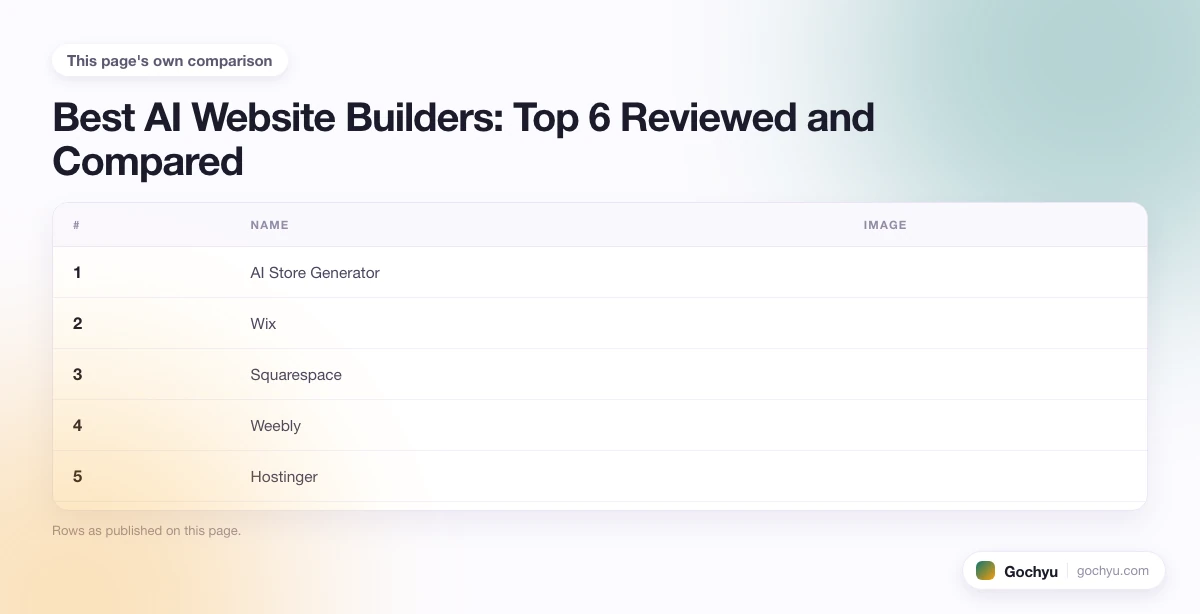
6 Best AI Website Builders
The platforms below all offer genuine AI-assisted website creation: they generate designs, suggest content, and help with SEO. Each one suits a different type of user. Read the breakdown for each and check which one matches your goals as an AI website creator or small business owner looking to get online fast.
AI Store Generator
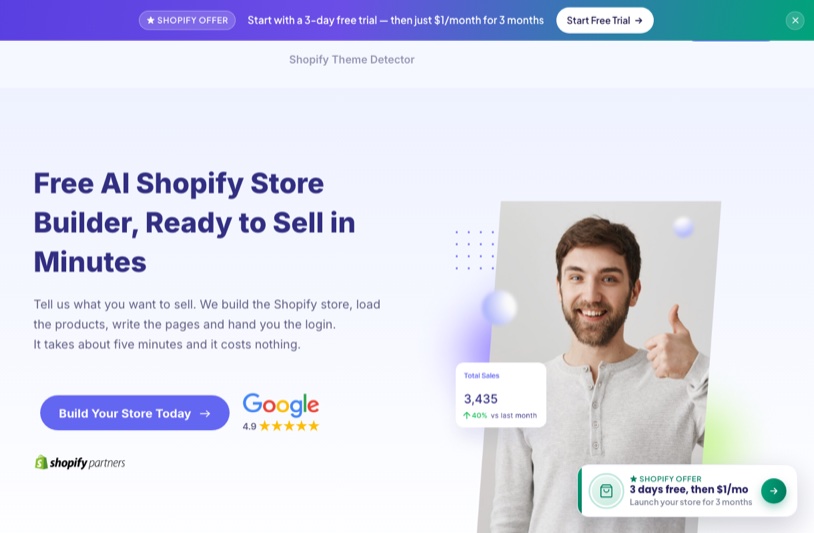
AI Store Generator is the fastest way to get a complete online store built by AI, and it is our sister site. You tell it what you want to sell, and it builds a full Shopify store for you: it picks the products, writes the pages, and sets up a theme, then hands you the login. The whole process takes about five minutes. If the website you are building is a store rather than a portfolio or a brochure site, this is the quickest route from an idea to something you can actually sell from, which is why it leads this list.
What sets AI Store Generator apart from a general website builder is how much it finishes for you. Every store arrives with ten products already chosen from what is selling in your niche, so you have something to advertise on day one. The product pages, policy pages, and the standard pages a buyer expects are written and in place before you log in, not left as placeholder text. You are not starting from a blank store and filling it in section by section yourself.
The store runs a theme designed around getting visitors to checkout, and every color, font, and section stays editable once it is live, so you are not locked into the first version you see. You can open a general store, a dropshipping store, or a print on demand store with the same process. Pick one of the researched niches or describe your own, and the AI builds the store around it.
The store builder itself is free, with no card needed to design a store and look it over as many times as you like. The store publishes into your own Shopify account, so you do need Shopify, which runs a three-day free trial and then one dollar a month for your first three months. AI Store Generator suits anyone whose main goal is to start selling quickly. If you need a portfolio, a service site, or a general business page instead, one of the platforms further down this list will fit your project better.
Wix

Wix is the most widely used AI website builder and for good reason. Its AI setup flow, called Wix ADI (Artificial Design Intelligence), asks you about your site's purpose, industry, and style preferences. Within a few minutes it generates a complete website with pages, images, and placeholder text already in place. You then edit inside Wix's drag-and-drop editor, which gives you near-pixel-level control over where every element sits on the page.
The AI doesn't stop at the initial build. Wix has a built-in AI text generator that writes headlines, product descriptions, and page copy matched to the tone you specify. If you get stuck on what to write, you can prompt the AI to produce a first draft and edit from there. There is also an AI image tool that finds and places stock photos that fit your content without you having to browse through a library manually.
Wix's SEO tools are AI-driven too. The platform's SEO Assistant analyzes your site and gives specific suggestions: add alt text to this image, shorten this title tag, add a keyword to this heading. It guides you through changes in plain English rather than dumping a list of technical tasks on you. This makes Wix a strong choice for anyone who wants their website to be findable in search without hiring an SEO specialist.
On top of that, Wix's AI chat widget can be trained on your business information to give visitors accurate, personalized answers. It learns from your FAQ content and pages, which means it can handle common questions automatically. For small business owners who don't want to be on call 24/7, that is a practical time-saver.
Wix has over 900 templates ranging from portfolios and restaurants to online stores and membership sites. The Wix App Market adds roughly 500 third-party tools covering email marketing, booking, loyalty programs, and more. As a full-featured AI website generator, it is hard to beat for variety and flexibility.
Squarespace

Squarespace is the AI website builder that consistently produces the best-looking results out of the box. Its roughly 180 templates are all professionally designed with consistent typography, spacing, and color use. When you start a new site, Squarespace asks about your goals and style, then recommends the templates most suited to your answers. The AI image editor automatically crops and resizes your photos to fit the chosen layout, saving you from the tedious work of resizing images for every section.
Squarespace's AI content tools include Blueprint, which generates a site structure for you, and an AI-powered text editor that can write or rewrite copy in a tone you select. If you are building a portfolio, a restaurant site, or a professional service site, the AI suggestions tend to be more on-brand and polished than what you get from other platforms. Squarespace understands that its users want things to look good first, and the AI tools reflect that priority.
The platform's SEO tools are built into the editor rather than tucked into a separate dashboard. As you add content, Squarespace suggests keywords, highlights missing meta descriptions, and checks title lengths in real time. For bloggers and content creators, there is a built-in AI that recommends related content and can help you write meta descriptions optimized for the search terms you are targeting.
Squarespace also builds in email marketing, analytics, and scheduling tools, all of which tie into the same account. The AI personalizes email campaigns based on subscriber behavior, which keeps your audience more engaged over time. For artists, photographers, and service businesses that want a professional website without piecing together multiple tools, Squarespace is often the best AI website builder on the market.
Weebly

Weebly is the most accessible AI website builder for people on a tight budget. It offers a genuine free plan with no expiry and no forced ads on your content pages. You can build and publish a full website for $0, which makes Weebly the go-to answer when someone asks whether there is a free AI website builder worth using. The paid plans start affordably and add features like a custom domain, expanded storage, and ecommerce tools.
The AI setup process at Weebly follows a familiar pattern: answer questions about your business type, style, and goals. The AI then produces a tailored template with suggested section layouts. What sets Weebly apart at this stage is that its suggestions lean practical rather than flashy. A small business owner gets a functional, clean result that is easy to edit rather than a design-heavy starting point that takes time to simplify.
Weebly's AI analytics feature is a standout that larger platforms often overlook. Once your site is live, the AI monitors traffic patterns, visitor behavior, and conversion data. It then surfaces specific suggestions: this page has a high bounce rate, consider shortening the introduction; this product page gets traffic but few purchases, try adding a stronger call to action. You get the kind of analysis that would otherwise require a separate analytics tool and someone to interpret the data.
The platform is now part of Square's ecosystem, which means ecommerce features connect directly to Square's payment processing, inventory management, and point-of-sale tools. If you run a physical shop alongside an online store, that integration is genuinely useful. The AI can also suggest product layouts and upsell placements based on what similar stores have found effective.
For anyone looking for a free AI website builder with real staying power, or a low-cost option that grows alongside a small business, Weebly is the strongest choice in this category.
Hostinger
Hostinger's AI website builder takes one of the fastest approaches to getting you online. You describe your business in a short text field, and the AI uses that description to generate a complete website including pages, headings, and content. You are not filling out a questionnaire step by step; you are writing a brief and letting the AI interpret it. The result is ready to review in under a minute.
One feature that makes Hostinger genuinely different is the AI heatmap. Before your site is even live, the heatmap predicts where visitors will look and click based on your layout. You can use those predictions to move important content and calls to action into the areas that will get the most attention. This kind of user behavior analysis is usually available only as an add-on tool on other platforms; Hostinger builds it directly into the website builder.
The Hostinger AI Writer works throughout your editing process. Struggling with an about page? Type a few notes about your background and the AI produces a draft. Need product descriptions? Feed in the key specs and the AI writes readable, conversion-focused copy. This is useful for business owners who know what they want to say but find writing for the web uncomfortable.
Hostinger's template library covers over 150 designs across industries, all fully responsive. The AI picks the most relevant templates based on your business description rather than making you browse manually. Social media integration is built in, so linking your site to your Instagram or Facebook account takes a few clicks rather than a plugin setup. Hostinger also integrates with WordPress, giving you access to the full WordPress plugin ecosystem if you ever need more advanced functionality.
Hostinger sits in a practical price range that makes it competitive against Wix and Squarespace, especially when you factor in hosting costs since Hostinger bundles hosting with the builder. For users who want speed, a built-in AI Writer, and the heatmap advantage, it is a strong pick.
Shopify

Shopify is the AI website builder built specifically for selling online. If your primary goal is to run an ecommerce store rather than a general business or portfolio site, Shopify's toolset is in a different category from the other platforms on this list. Its AI features are optimized for store performance: generating product descriptions, personalizing marketing campaigns, and predicting inventory needs.
Shopify Magic is the umbrella name for Shopify's AI tools. The most used feature is the product description generator: you enter a product name, a few key details, and the tone you want, and Shopify Magic writes a ready-to-publish description. Store owners with large catalogs save significant time this way. The AI can also generate email subject lines, blog post outlines, and FAQ responses tailored to your store's products.
Shopify's AI also works behind the scenes on SEO. It analyzes your product pages and blog content, flags missing meta tags, and suggests title improvements. The platform's store structure is already search-engine-friendly by default, which means new store owners start with a reasonable SEO foundation without having to configure anything manually.
Predictive inventory analytics is one of Shopify's more distinctive AI features. The system tracks historical sales patterns and flags products that are likely to sell out before your next restock. For stores with seasonal demand or supply chain variability, this early warning is worth more than any design feature.
Shopify powers over 1.7 million businesses across 175 countries and has one of the largest app ecosystems of any ecommerce platform. If you need a specific integration, whether it is a loyalty program, a subscription billing tool, or a product review system, there is almost certainly a Shopify app for it. That said, if you are not primarily focused on selling products, Wix or Squarespace will serve you better and cost less. For a detailed comparison, see our guide to website builders for ecommerce.
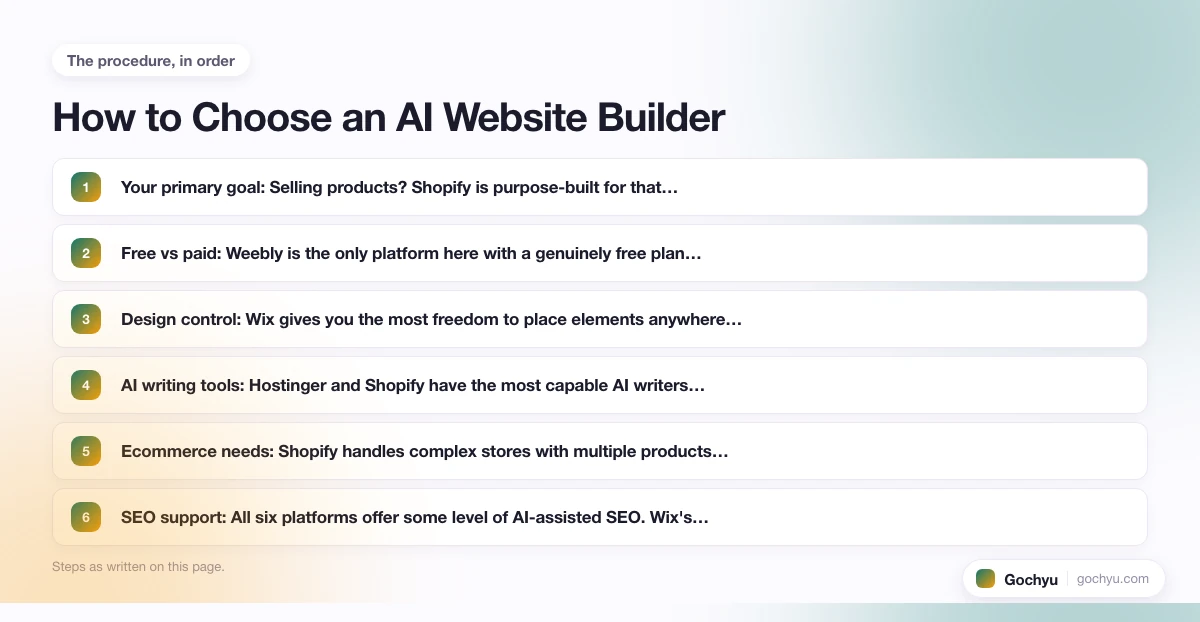
How to Choose an AI Website Builder
The right AI website builder depends on what you need the site to do, how much you want to spend, and how much design control matters to you. Here are the key factors to consider before picking one.
- Your primary goal: Selling products? Shopify is purpose-built for that. Building a portfolio or professional service site? Squarespace's design quality is hard to beat. Starting a general business site on a budget? Wix or Weebly cover most needs at a lower cost.
- Free vs paid: Weebly is the only platform here with a genuinely free plan that does not expire. Wix has a free tier but it adds Wix branding. All other platforms require a paid subscription to publish without restrictions.
- Design control: Wix gives you the most freedom to place elements anywhere on the page. Squarespace uses section-based layouts that keep things consistent and mobile-friendly but limit creative placement. Weebly and Hostinger sit in between.
- AI writing tools: Hostinger and Shopify have the most capable AI writers built directly into the platform. Wix and Squarespace both offer AI text tools but they are more limited in scope.
- Ecommerce needs: Shopify handles complex stores with multiple products, inventory tracking, and advanced marketing. Wix and Weebly handle smaller shops well. Squarespace has solid ecommerce features but fewer third-party integrations.
- SEO support: All six platforms offer some level of AI-assisted SEO. Wix's SEO Assistant is the most hands-on guide for beginners. Squarespace's built-in SEO tools are tightly integrated and easy to act on.
If you are still unsure where to start, Wix is a safe default. It covers the widest range of use cases, has the largest template library, and its AI tools work well for beginners and more experienced users alike. If design quality is your top priority and you are willing to pay a bit more per month, Squarespace is worth the extra cost. For a broader look at how these tools compare when building a site from scratch, see our guide on when and how to build a website.
Frequently Asked Questions
Here are answers to the most common questions people ask about AI website builders.
What is an AI website builder?
An AI website builder is a platform that uses artificial intelligence to help you create a website faster and with less effort. Instead of starting from a blank canvas, you answer a few questions about your business or goals, and the AI generates a design, picks a layout, and sometimes even writes placeholder content. You can then edit and refine the result without touching any code.
Which AI website builder is best for beginners?
Wix is the most beginner-friendly AI website builder because its setup process walks you through every step and the editor is hard to break. Weebly is a close second for simplicity, especially if cost is a factor since it offers a free plan. Squarespace is also manageable for newcomers who want polished results out of the box.
Is there a free AI website builder?
Yes. Weebly offers a genuine free plan with no expiry date and no forced upgrade. Wix also has a free tier, though it shows Wix branding on your domain. If you want a custom domain and no ads, you will need a paid plan on either platform, but both start at affordable monthly rates.
How does an AI website builder work?
You typically start by answering questions about your site's purpose, industry, and style preferences. The platform's AI uses your answers to select a template, arrange sections, and in some cases generate starter text. From there, you edit content, swap images, and adjust colors using a drag-and-drop interface. The AI may also continue to assist with tasks like writing product descriptions or suggesting SEO improvements.
Can an AI website builder create a complete website?
An AI website builder can create a working, publishable website from scratch in minutes. It handles layout, structure, and basic content suggestions. What it cannot do is replace your specific business information, your photos, or your brand voice. Think of it as building the shell of the house: fast, structurally sound, and ready for you to fill in.
Conclusion: Which AI Website Builder Should You Pick?
The six platforms in this guide each handle AI website building well, but they serve different users. Wix wins on flexibility and the breadth of its AI tools. Squarespace wins on design quality. Weebly wins for anyone who needs a free option. Hostinger wins for speed of setup and its unique AI heatmap. Shopify wins for ecommerce stores that need inventory management and a large app ecosystem.
Start with Wix if you are not sure where to begin. Its AI walks you through the entire setup, the editor is forgiving, and you can switch directions without losing your work. If you already know your site is primarily a store, start with Shopify. If design matters more than anything else, go with Squarespace. Any of the six platforms on this list will get you from idea to published website in a day or less, which is the real promise of an AI website builder done right.