To hide your address on Shopify, go to Settings > General > Store Details, click Edit, replace your home address with a PO box or virtual address, and click Save. Shopify still holds your real address for billing but customers won't see it.
Running a store from home makes address privacy genuinely important. Your business address can appear in your store footer, email notifications, legal pages like your refund policy, and checkout pages. Each of those locations requires a slightly different fix, and not all of them are obvious from the Shopify admin panel.
This guide walks through every place your address shows up, how to replace or remove it in each spot, and what your options are when Shopify requires a physical address you'd rather keep private.
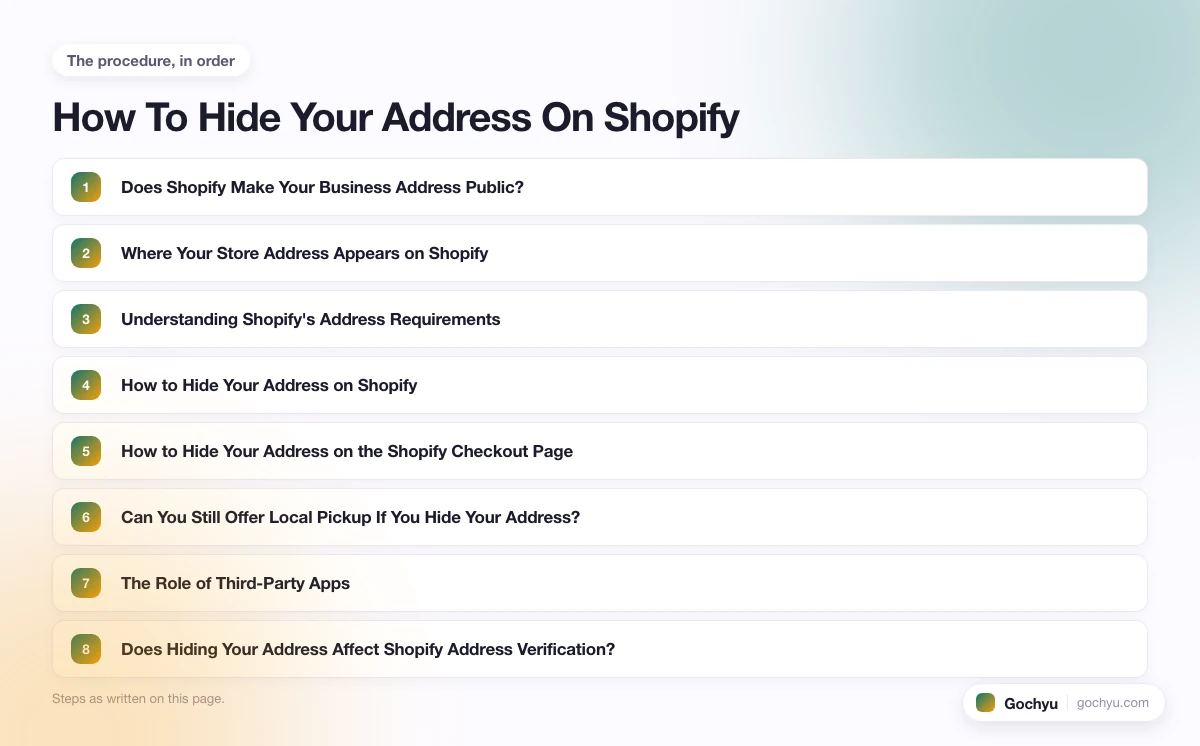
Does Shopify Make Your Business Address Public?
Your Shopify business address is not automatically visible to customers, but it can appear in several places if you don't actively manage it. Shopify uses your store address internally for tax calculations, shipping rate zones, and payment processing, none of which expose it to shoppers. However, many themes display a footer address by default, and Shopify's built-in email notification templates include your store address in their standard layout.
The short answer: your address is not public by default, but it can become public through theme settings and email templates if you don't check each one.
Where Your Store Address Appears on Shopify
Before you can hide your address, you need to know where it lives. There are five main places:
- Store settings (Settings > General): This is the primary store address Shopify uses for tax and shipping. Replacing it here with a PO box or virtual address is the first step.
- Theme footer: Many Shopify themes pull your address into the footer automatically. Check your theme's footer settings or contact section. You may need to manually remove or replace the address text there.
- Email notifications: Shopify's default order confirmation, shipping, and other customer emails include your store address. Go to Settings > Notifications, open each template, and edit or remove the address from the footer HTML.
- Legal pages: If you used Shopify's auto-generated refund, privacy, or terms pages, your store address may be embedded in those documents. Review them under Settings > Policies.
- Checkout page: Some themes surface your store address on the checkout page or in the order summary. This is covered in the dedicated section below.
Understanding Shopify's Address Requirements
Shopify requires a physical address for tax calculations, shipping rates, and legal compliance. This is also what triggers Shopify's address verification process. When you add payment methods or apply for Shopify Payments, Shopify verifies your business address matches your submitted documentation. This doesn't mean you have to use your home address. Accepted alternatives include:
- PO Box: Shopify accepts PO box addresses for store settings. A PO box costs around $50-$200 per year through USPS depending on location and box size. It's the simplest option for most home-based sellers.
- Virtual address: Services like iPostal1, Anytime Mailbox, or Regus provide a real street address that receives and forwards your mail. These typically cost $10-$30/month and look more professional than a PO box on storefront pages.
- Co-working space address: If you're already paying for a co-working membership, many spaces allow you to use their address as your registered business address at no extra charge.
Note: Shopify Payments requires a business address that matches your bank account or business registration. A virtual address is generally accepted; a PO box alone may not satisfy Shopify Payments verification in some regions.
How to Hide Your Address on Shopify
Here's the step-by-step process to update your primary store address:
- From your Shopify admin, go to Settings and then General.
- In the General settings, find the Store Details section.
- Click Edit next to the address you want to change.
- Input your new address (PO box or virtual address) and click Save.
Once this is done, update your email notification templates and check your theme's footer or contact section to make sure the old address isn't hard-coded anywhere else.
How to Hide Your Address on the Shopify Checkout Page
The checkout page is handled differently from the rest of your store. It runs on Shopify's infrastructure, not your theme. Here's how your address can appear on checkout and how to remove it:
- Order summary footer: Some Shopify themes insert your store address into the checkout order summary. This is typically controlled by a theme setting. Go to Online Store > Themes > Customize, navigate to the checkout section, and look for a store information or footer field. Remove or replace the address there.
- Checkout email confirmation: If your Shopify notification template includes your address in the email footer, it will show on the order confirmation customers see after checking out. Edit this under Settings > Notifications > Order confirmed.
- Shopify Plus checkout customization: Merchants on Shopify Plus can use the checkout.liquid file or the checkout editor to remove address fields entirely. Standard plan merchants are limited to what the theme and notification settings expose.
If your address is appearing at checkout and you can't locate where it's pulling from in your theme settings, a third-party app (see below) is the most reliable way to remove it across all checkout touchpoints.
Can You Still Offer Local Pickup If You Hide Your Address?
Yes. Hiding your address from your storefront does not disable local pickup. Shopify's local pickup feature is configured under Settings > Shipping and delivery > Local pickup, and the pickup location address is managed separately from your general store address. You can set a pickup location (your actual address, a warehouse, or a third-party location) that only appears during checkout when customers choose pickup, rather than displaying it publicly across your store.
The Role of Third-Party Apps
If you need more granular control over where your address appears, third-party apps offer additional options:
- Address Hider: Automatically hides your address on the checkout page. No coding required, easy to install.
- Hide Address: Removes your address site-wide, useful if your theme is pulling it from multiple locations and manual editing isn't catching all instances.
- Address Guard: Hides your exact address and displays a map with a general area instead, useful if you want to convey a location without revealing a specific street address.
Does Hiding Your Address Affect Shopify Address Verification?
Shopify's address verification process happens on the backend. It's between you and Shopify, not visible to customers. Shopify address verification is typically triggered when you add Shopify Payments, connect a payment gateway, sell in certain regulated regions, or reach transaction thresholds that require identity confirmation. When you submit your address for verification, Shopify checks it against your provided documentation. Updating your public-facing store address to a PO box or virtual address does not affect this backend verification, as long as the address you provide during the payment setup matches your actual business documentation.
If you receive a "Shopify address verification" prompt, it means Shopify needs to confirm your business details, not that your address has been exposed to customers.
The Impact of Hiding Your Address
A few considerations before you finalize your setup:
- Trust: A visible business address can increase customer trust, especially for first-time buyers. A PO box or virtual address still provides a verifiable location without exposing your home.
- Legal requirements: In the EU under GDPR and the eCommerce Directive, businesses are required to display a registered business address. A virtual address or registered agent address satisfies this in most cases. In the UK under the Companies Act, limited companies must display their registered office address; a virtual address registered with Companies House is accepted. If you're selling internationally, verify local requirements. A virtual address is the most compliant option across most jurisdictions.
- Local SEO: If you're targeting local search traffic, your business address contributes to Google Business Profile and local pack rankings. A PO box address can still be registered with Google, but a real street address (virtual or otherwise) performs better for local SEO purposes.
Final Steps: Hiding Your Shopify Store Address
Protecting your home address as a Shopify store owner is not just about privacy. It's about running a more professional business. A PO box or virtual mailbox address gives you a legitimate business address to use across your store, your emails, and your legal pages, without ever exposing where you actually live.
Start with Settings > General to update your primary store address, then audit your email notification templates and your theme footer. Check the checkout page separately. It's the most frequently overlooked location. Use a virtual address service if you want a real street address rather than a PO box, and verify your local regulations if you sell internationally.
* read the rest of the post and open up an offer