Shopify's default setting for abandoned cart emails can sometimes clash with your marketing strategy or other email automation tools. This guide walks you through the exact steps to disable these emails and covers how to replace them with a third-party solution so you stay in control of every message your customers receive.
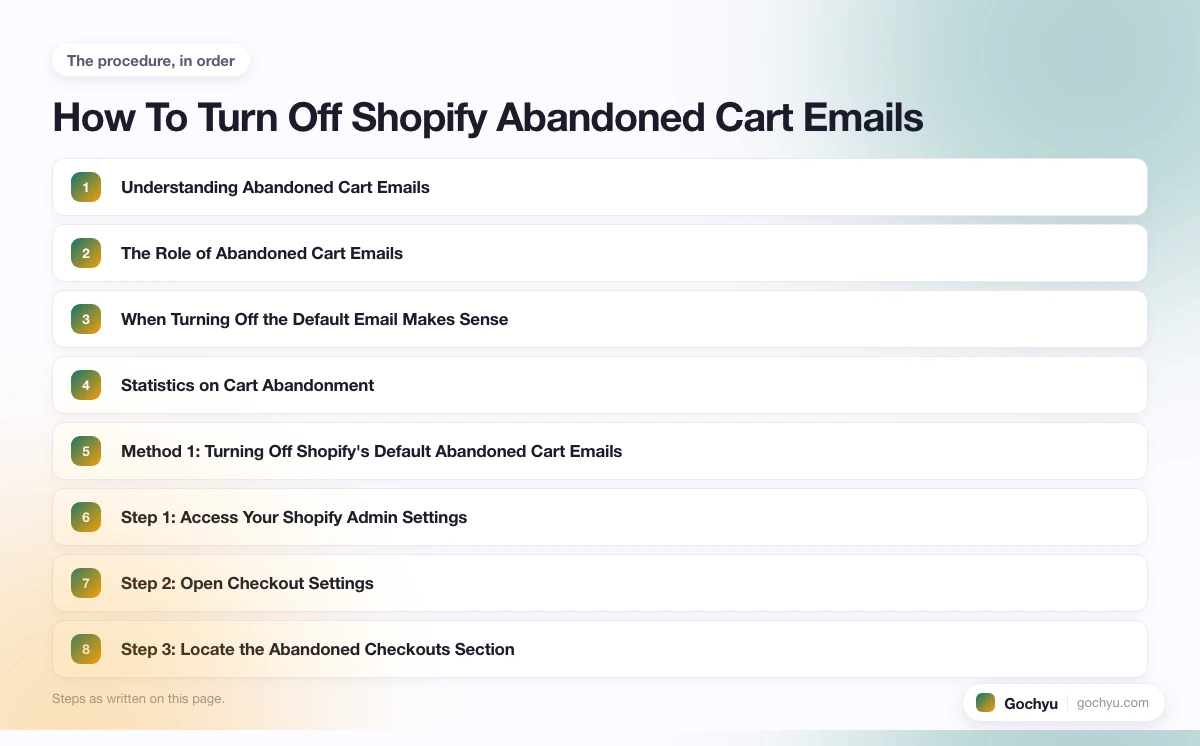
Understanding Abandoned Cart Emails
The Role of Abandoned Cart Emails
Abandoned cart emails are automated reminders that go out to shoppers who added items to their cart but never completed the purchase. They are one of the highest-converting email types in ecommerce because they target people who already showed clear buying intent. A well-timed message with a relevant incentive can bring a meaningful percentage of those shoppers back.
Shopify sends one default abandoned cart email roughly 10 hours after checkout abandonment. It is plain and functional but limited. You cannot change the timing, split-test the subject line, segment by purchase history, or layer in multiple follow-ups. For stores with an active email marketing strategy, the default email often conflicts with a sequence already running through a third-party platform.
When Turning Off the Default Email Makes Sense
There are three common situations where disabling Shopify's built-in abandoned cart email is the right call:
- You already use a dedicated email platform. Tools like Klaviyo, MailerLite, and ConvertKit all have cart abandonment workflows. If both Shopify and your email platform send a recovery email, customers get duplicate messages, which damages trust and increases unsubscribes.
- You want multi-step sequences. Shopify sends a single email. Third-party platforms let you send two or three follow-ups spaced days apart, add SMS touchpoints, or trigger different messages based on cart value.
- You need brand-consistent design. The default Shopify abandoned cart email uses a generic template. If your brand has a strong visual identity, a plain email can feel off and reduce click-through rates.
Statistics on Cart Abandonment
Cart abandonment rates average around 70% across ecommerce as a whole, and climb to roughly 85% on mobile devices. Unexpected shipping costs, forced account creation, and a slow or complicated checkout are the most frequently cited reasons. Recovery emails address the intent gap by bringing people back after they've had time to think. Open rates for cart recovery emails are typically two to three times higher than promotional emails because the recipient already knows what they're being reminded about.
Method 1: Turning Off Shopify's Default Abandoned Cart Emails
Step 1: Access Your Shopify Admin Settings
Log in to your Shopify admin and click on "Settings" in the bottom-left corner of the dashboard. This opens the settings panel where all store configuration options are managed.
Step 2: Open Checkout Settings
Inside the Settings menu, select "Checkout." This section controls all checkout behavior, including email notifications sent during and after the checkout process.
Step 3: Locate the Abandoned Checkouts Section
Scroll down the Checkout settings page until you find the section labeled "Abandoned checkouts." You will see a checkbox that reads "Automatically send abandoned checkout emails." By default, this box is checked.
Step 4: Uncheck and Save
Uncheck the box to stop Shopify from sending the default abandoned cart email. Click "Save" at the top right of the page. Shopify will no longer send automated recovery emails when a customer abandons their cart. The change takes effect immediately for any new abandoned checkouts.
Method 2: Replacing Shopify's Emails With a Third-Party Tool
Why Third-Party Email Services Outperform the Default
Third-party email services like MailerLite, ConvertKit, and Klaviyo give you real control over abandoned cart recovery. You can build sequences with multiple emails, set custom delays, create different flows based on cart value or customer segment, and A/B test subject lines. These features are not available in Shopify's built-in email.
The average recovery sequence using a dedicated platform looks like this: a first email one hour after abandonment, a second email 24 hours later with a product reminder, and a third email 48 to 72 hours later with a small incentive like free shipping. That three-email sequence consistently outperforms a single email sent at a fixed 10-hour delay.
For a comparison of the top tools in this category, see the guide to the best cart recovery apps for Shopify.
Setting Up a Third-Party Integration
Most major email platforms connect to Shopify through a native app in the Shopify App Store. Once installed, the app listens for checkout events and triggers your abandonment flow automatically. The setup process generally takes 15 to 30 minutes:
- Install the email platform's Shopify app from the App Store.
- Authorize the connection so the app can read checkout and customer data.
- Build your abandoned cart automation in the platform's workflow editor.
- Set your triggers, delays, and email templates.
- Test with a real abandoned checkout before going live.
Once the third-party tool is live and confirmed to be firing correctly, go back to Shopify's Checkout settings and turn off the default email using Method 1 above. Running both at the same time will result in customers getting two separate recovery emails.
Best Practices for Cart Recovery Email Content
The content of your recovery emails matters as much as the timing. A few principles that consistently improve recovery rates:
- Show the abandoned product. Include the product image, name, and price in the email body. Customers often forget exactly what they were looking at.
- Keep the subject line direct. "You left something behind" outperforms vague curiosity-bait like "Did you forget us?" because it sets clear expectations.
- Address the likely objection. If your cart has a high average value, address shipping costs or return policy in the email. If customers abandon at the payment step, mention secure checkout.
- Reserve incentives for the second or third email. Offering a discount in the first email trains customers to abandon carts deliberately to get a coupon. Introduce any discount only after the first follow-up goes unanswered.
For inspiration on what works, browsing Shopify abandoned cart email templates can give you a starting point before you build your own.
Maximizing Email Marketing Effectiveness After Disabling the Default
Segmenting Your Recovery Audience
Not every abandoned cart deserves the same message. A shopper who abandoned a $12 item is a different case from someone who left behind a $400 order. Third-party platforms let you fork your flows based on cart value, allowing you to apply a discount to high-value abandons while keeping margins intact on low-value ones.
You can also differentiate between first-time visitors and returning customers. A returning customer who abandons is more likely to be comparison shopping or waiting for payday. A first-time visitor may have hesitated due to trust. Those two segments benefit from different messaging, and a dedicated email platform makes that segmentation straightforward.
Analyzing Campaign Performance
Once your third-party abandonment flow is running, track these metrics weekly:
- Open rate -- aim for 40% or higher on the first email
- Click-through rate -- 10% or higher indicates the email content is relevant
- Recovery rate -- the percentage of abandoned carts that result in a completed purchase
- Revenue per recipient -- the clearest measure of whether your sequence is worth the effort
Review these numbers monthly and test one variable at a time (subject line, send time, number of emails, incentive) to identify what improves recovery rates for your specific audience.
Keeping Your Email List Clean
Cart recovery emails only go to customers who provided an email address during checkout. Shopify captures the email early in the checkout flow, so even incomplete checkouts have an address attached. Over time, your abandonment flows will accumulate unsubscribes and bounces. Remove unsubscribes immediately and suppress bounced addresses monthly. A clean list improves deliverability for all your campaigns, not just abandonment flows.
Conclusion: How to Turn Off Shopify Abandoned Cart Emails
Disabling Shopify's default abandoned cart email is a straightforward setting change in Checkout settings. The real work comes after: setting up a third-party flow that gives you full control over timing, content, and segmentation. Whether you turn off the default because it conflicts with an existing platform or because you want a more targeted approach, the process takes under an hour and the results are measurable within the first week of running a properly structured recovery sequence.
* read the rest of the post and open up an offer