
To create a shipping label on Shopify, go to Orders in your admin, open the order you want to ship, scroll to the Fulfillment section, and click Create shipping label. You select the carrier, enter package dimensions and weight, purchase the label, and print it - all within Shopify. This guide covers the full process, including bulk label creation, label presets, third-party shipping apps, and what to do when you need a custom template.
What Carriers Does Shopify Support for Shipping Labels?
Shopify Shipping supports the following carriers natively, without requiring a separate account:
- USPS - domestic US, with discounts up to 88% off retail rates on some services
- UPS - domestic and international from the US
- DHL Express - international shipping from the US
- Canada Post - for Canadian merchants
- Sendle - Australia-based merchants
When choosing a carrier, compare rates and delivery speed for each shipment's destination and package size. Shopify displays real-time rate comparisons during the label creation process, so you can make the decision at the point of purchase rather than in advance.
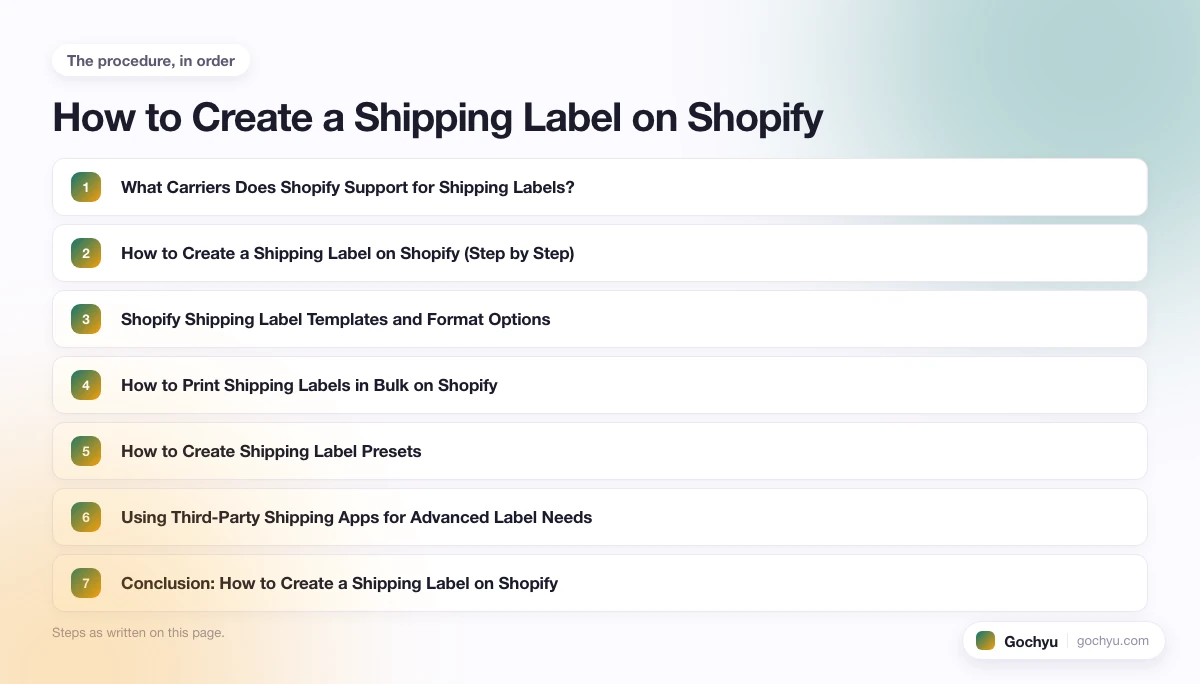
How to Create a Shipping Label on Shopify (Step by Step)
- Log in to your Shopify admin and click Orders in the left sidebar.
- Open the order you want to fulfill by clicking on the order number.
- In the Fulfillment section, click Create shipping label.
- Confirm or update the shipping address - Shopify pre-fills this from the customer's order, but verify for accuracy.
- Enter your package details: weight, dimensions (length × width × height), and package type.
- Select your preferred carrier and service level (e.g., USPS Priority Mail, UPS Ground). Shopify shows the cost and estimated delivery time for each option.
- Click Buy shipping label. The label cost is deducted from your Shopify Payments balance or charged to your billing method.
- Choose your label format: Thermal (4×6"), Letter (8.5×11"), or A4. Select the format your printer supports.
- Click Print label.
The order is automatically marked as fulfilled and the customer receives a shipping confirmation email with their tracking number.
Shopify Shipping Label Templates and Format Options
Shopify generates shipping labels in a standard carrier format - these are not customizable design templates, but you can choose the output format to match your printer:
- Thermal (4×6"): Standard label printer format. Works with Rollo, Zebra, DYMO 4XL, and similar direct thermal printers. This is the most common format for high-volume shipping.
- Letter (8.5×11"): Prints two labels per page on a standard inkjet or laser printer. Best for low-volume shipping without a dedicated label printer.
- A4: Same as Letter but for A4 paper - standard outside North America.
Shopify does not currently offer custom-branded shipping label templates (i.e., adding your logo to the carrier label itself). If you need branded packaging inserts or packing slips with your logo, those are handled separately via the Packing Slips section under Settings → Notifications.
How to Print Shipping Labels in Bulk on Shopify
For high-volume days, Shopify lets you purchase and print up to 100 shipping labels at once:
- Go to Orders in your admin.
- Check the boxes next to all the orders you want to ship.
- Click Create shipping labels in the action bar at the top.
- Review each order's shipping details - Shopify will flag any orders with missing information.
- Purchase all labels and print them as a batch.
Bulk label printing also generates packing slips and customs forms where required, so you can process an entire fulfillment run in a single session.
How to Create Shipping Label Presets
If you regularly ship the same package size, presets eliminate the need to re-enter dimensions every time:
- During the label creation process, after entering your package dimensions, look for the option to Save as preset.
- Name the preset (e.g., "Small box," "Large envelope") so it's easy to identify.
- On future orders, your saved presets appear as a dropdown in the package details section - select one to auto-fill all dimensions.
Presets are especially useful for stores with a standard product catalog where most orders ship in the same box size.
Using Third-Party Shipping Apps for Advanced Label Needs
Shopify's built-in shipping covers most merchants, but third-party apps add capabilities like multi-carrier rate shopping, international customs automation, and advanced return label workflows. The most widely used options include ShipStation, Shippo, and Easyship. You can find a broader list of third-party shipping applications in the Shopify App Store.
These apps are worth considering if you ship internationally to more than 5–10 countries regularly (customs documentation complexity grows quickly), or if you want to offer real-time carrier rate comparisons directly on your checkout page.
Once you have printed the label and dropped off the package, the order moves to fulfilled status. If you need a refresher on the full process from order to shipment, see our guide on how to fulfill orders on Shopify, which covers manual fulfillment, partial shipments, bulk fulfillment, and common errors.
Conclusion: How to Create a Shipping Label on Shopify
Creating a shipping label on Shopify is a straightforward process: open the order, click Create shipping label, enter the package details, select a carrier, purchase, and print. The built-in Shopify Shipping rates are competitive for most domestic US shipments, and the preset system speeds up repeat fulfillment considerably. For international or high-volume operations, a third-party shipping app adds capabilities worth the cost.
* read the rest of the post and open up an offer