The Shop App is owned by Shopify Inc. Shopify built, launched, and operates it as a direct extension of its commerce platform. The Shop App owner is Shopify itself, not a third-party developer, not a subsidiary, and not an independent company. Shopify created it in 2020 to give consumers a dedicated shopping experience connected to the millions of stores running on Shopify's platform. The separate name and branding ("Shop" rather than "Shopify") causes genuine confusion, but the ownership is straightforward.
Who Owns the Shop App?
Shopify Inc. is the sole owner of the Shop App. The question of Shop App ownership comes up often because the app feels like its own product: separate branding, separate download, separate purpose. But it was developed entirely in-house by Shopify's engineering team and remains under Shopify's direct control. So yes, Shopify does own the Shop App. There is no independent parent company, no acquisition from a third party, and no outside ownership stake.
Shopify is a publicly traded company (NYSE: SHOP), and as the parent company of all its products, it holds complete ownership of the Shop App. The company was founded by Tobi Lutke in 2006. Lutke still holds roughly 40% of voting power through supervoting shares. When people ask "who owns the Shop App," "does Shopify own the Shop App," or "what company owns the Shop App," the answer traces all the way up to Shopify's board and its founder.
How Did Shopify Build the Shop App?
The Shop App didn't appear out of nowhere. Its origin traces back to Arrive, a package tracking app that launched on Product Hunt in December 2017, timed for the holiday shopping season. Arrive let shoppers track shipments from any retailer in one place. It gained quick traction because it solved a real problem: most people tracked packages by hunting through their email for individual carrier links. Arrive brought everything into one screen.
Shopify acquired Arrive in early 2018 and saw it as more than a tracking tool. It was a direct line to consumers. Rather than Shopify always sitting behind the scenes as the merchant's infrastructure, Arrive gave Shopify a reason to exist on a shopper's phone. Carl Rivera, who joined Shopify to lead the project, began expanding the concept through 2018 and 2019.
By April 2020, Shopify rebranded Arrive as the Shop App and added three major features on top of the original tracking functionality:
- A personalized product feed showing items from Shopify-powered stores based on purchase history and browsing behavior
- Shop Pay one-tap checkout using saved payment and shipping details
- Store following so shoppers could subscribe to updates from their favorite brands
This evolution from a simple tracking tool into a full shopping app is what makes Shop App distinct among e-commerce platforms. It wasn't designed as a marketplace from day one. It grew from a real consumer need (package tracking) into a broader shopping experience.
Who Runs the Shop App?
Carl Rivera built and initially ran the Shop App. As VP of Product for Shop, Rivera led the product from its Arrive origins through the 2020 rebrand and the addition of Shop Pay integration and product discovery. Rivera later moved into broader roles within Shopify's product organization as the app scaled.
Today, the Shop App operates as a product line within Shopify's consumer-facing division. It is not a standalone business, a separate subsidiary, or an independently managed unit. The team that builds and maintains Shop App reports into Shopify's core product organization. Strategic decisions, such as which features to build, how to grow the shopper base, and how Shop App integrates with new commerce channels like TikTok Shop, come from Shopify's executive leadership.
So when someone asks "who runs the Shop App," the answer is: Shopify's product and engineering teams, operating under Shopify's executive leadership, with CEO Tobi Lutke setting the overall strategic direction across all Shopify products including Shop App.
What Does the Shop App Actually Do?
The Shop App is a free mobile shopping application designed for consumers. It serves three core functions:
- Order tracking: Shop App automatically pulls in order confirmation emails and displays real-time shipping updates in one place, across any Shopify store you've purchased from. No manual tracking numbers required.
- Product discovery: Shop App shows a personalized feed of products from Shopify stores based on your purchase history and browsing behavior, letting you discover new brands without leaving the app.
- Shop Pay checkout: When you find something you want to buy, Shop Pay enables one-tap checkout using your saved payment details and shipping address. The same Shop Pay technology powers accelerated checkout across Shopify stores on the web.
As of late 2024, Shop Pay had over 200 million registered users worldwide, and merchants using Shop Pay report conversion rates up to 50% higher than standard guest checkout. Three out of four Shop Pay transactions happen on mobile devices.
Is Shop App the Same as Shopify?
No. Shop App and Shopify are not the same thing. This is one of the most common points of confusion, especially for people asking "is Shop the same as Shopify" or "are Shop and Shopify the same company." They are both owned by Shopify Inc. but they serve completely different users and solve different problems.
Shopify is a commerce platform for merchants. It gives businesses the tools to build an online store, manage products and inventory, process payments, and run marketing campaigns. Shopify is what powers the store: the backend infrastructure that merchants subscribe to.
Shop App is a consumer shopping app. Shoppers download it to track orders, browse products, and checkout faster. Shop App doesn't give merchants any store-building tools. It's purely a buyer-facing experience.
So while Shopify and the Shop App are the same company (both under Shopify Inc.), they are not the same product. Think of it like how Google owns both Google Search and YouTube: same parent company, completely different products serving different purposes.
The connection: Shop App exclusively surfaces products from Shopify-powered stores. It uses Shopify's payment infrastructure (Shop Pay) and Shopify's order data. You cannot find products from WooCommerce, BigCommerce, or other platforms on the Shop App.
Is Shop Pay the Same as Shop App?
No. Shop Pay and the Shop App are related but different. This is a common source of confusion because both start with "Shop" and both are owned by Shopify.
Shop Pay is a payment method: specifically, an accelerated checkout option that saves a shopper's payment and shipping details so they can complete purchases in one tap. Shop Pay works across thousands of Shopify-powered stores on the web, even if those shoppers have never downloaded the Shop App. You encounter Shop Pay at checkout on a website, not inside an app.
Shop App is the mobile application. It's a full shopping platform where you track orders, browse product feeds, and use Shop Pay to checkout. Shop App contains Shop Pay as a feature, but Shop Pay exists independently of the Shop App.
In practical terms: you can use Shop Pay without ever downloading the Shop App. And you can use the Shop App without having used Shop Pay on a website before. They share the same payment infrastructure and are both owned by Shopify, but they solve different parts of the shopping experience.
Can Non-Shopify Stores Use the Shop App?
No. The Shop App is exclusively built around the Shopify ecosystem. Only stores running on Shopify's platform can appear in the Shop App's product discovery feed, and only Shopify orders are tracked within the app. If a merchant runs their store on WooCommerce, BigCommerce, Wix, or any other platform, their products will not appear in Shop App and their customers will not get order tracking through it.
This exclusivity is intentional. It's central to Shopify's strategy of keeping both merchants and buyers within its ecosystem. From Shopify's perspective, Shop App is a competitive advantage that merchants on other platforms don't have access to.
What Shopify Detects vs. What Shop App Shows
One point that trips up new merchants: Shopify detecting a store's technology stack (themes, apps, payment providers) is completely separate from what Shop App displays. Shop App shows products, orders, and store profiles. It doesn't reveal which apps a Shopify store uses or what theme it runs on.
If you want to analyze which Shopify theme or apps a competitor store uses, a dedicated Shopify theme and app detector gives you that information instantly. Shop App is a shopping destination for buyers, not a store intelligence tool.
How Does Shop App Integrate with Shopify Stores?
If you run a Shopify store, your products are automatically eligible to appear in Shop App. No separate setup is required. Merchants can access the Shop channel directly from their Shopify admin to manage how their store appears in the app, customize their Shop store profile, and view Shop-specific analytics.
Key integration points for merchants:
- Shop Store profile: A branded page within Shop App where customers can browse your products, follow your store, and get notified of new releases or sales.
- Shop Pay: Your checkout automatically supports Shop Pay if you use Shopify Payments, giving returning Shop App users one-tap purchase capability.
- Order status updates: Shopify sends fulfillment data directly to Shop App, so customers who buy from you get automatic tracking without any extra integration work on your end.
- Social commerce connections: Shopify has built integrations with TikTok Shop and Instagram that funnel purchases back through Shopify's checkout, which means those orders also appear in customers' Shop App feeds.
Is Shop App Free?
Yes. Shop App is free for shoppers to download and use on iOS and Android. There is no subscription, no membership fee, and no cost to access order tracking, the shopping feed, or Shop Pay checkout.
For merchants, listing your Shopify store in Shop App is also free. Shopify does not charge a separate fee to appear in the Shop App marketplace. The cost of being on Shop App is included in your existing Shopify subscription. However, standard Shopify Payments processing fees still apply to transactions made through Shop Pay (typically 2.4% to 2.9% plus $0.30 per transaction, depending on your Shopify plan).
Shop App vs Amazon: Why Shopify Built a Consumer App
The Shop App is Shopify's answer to a specific strategic problem: Amazon owns the consumer relationship. When someone buys from an independent brand, they often do it through Amazon. The merchant loses control of the customer experience, data, and repeat purchase potential.
Shop App addresses that by giving Shopify a direct consumer touchpoint. Instead of shoppers going to Amazon to reorder or track packages, they open the Shop App. This keeps buyers within the Shopify ecosystem and routes them back to independent Shopify-powered stores rather than Amazon listings.
This strategy appears to be working. Over 53% of top Shopify merchants actively use Shop Pay, up from 40% in 2021. And because Shop App prioritizes organic product recommendations from brands you already follow (rather than paid advertisements), it offers a different shopping experience than Amazon's ad-heavy marketplace.
What Merchants Should Know About Shop App
While Shop App provides free distribution and higher conversion rates, merchants should understand the trade-offs before relying on it heavily:
- Brand visibility: Customers receive order confirmations and tracking updates branded as "Shop" rather than your store name. This can reduce your brand's direct recognition with repeat buyers.
- Limited customization: Your Shop Store profile offers basic branding options, but you cannot add custom product configurators, file uploads, or unique checkout experiences.
- Data access: Shopify gains broad consumer behavior data across its ecosystem, while individual merchants see limited post-purchase engagement data from Shop App specifically.
- Exclusive to Shopify: Only Shopify-powered stores appear in Shop App, which is an advantage if you're on Shopify but meaningless if you use another platform.
For most Shopify merchants, the benefits outweigh these concerns, especially since listing is free and automatic. But it's worth understanding that Shop App serves Shopify's ecosystem growth goals alongside your individual store's interests.
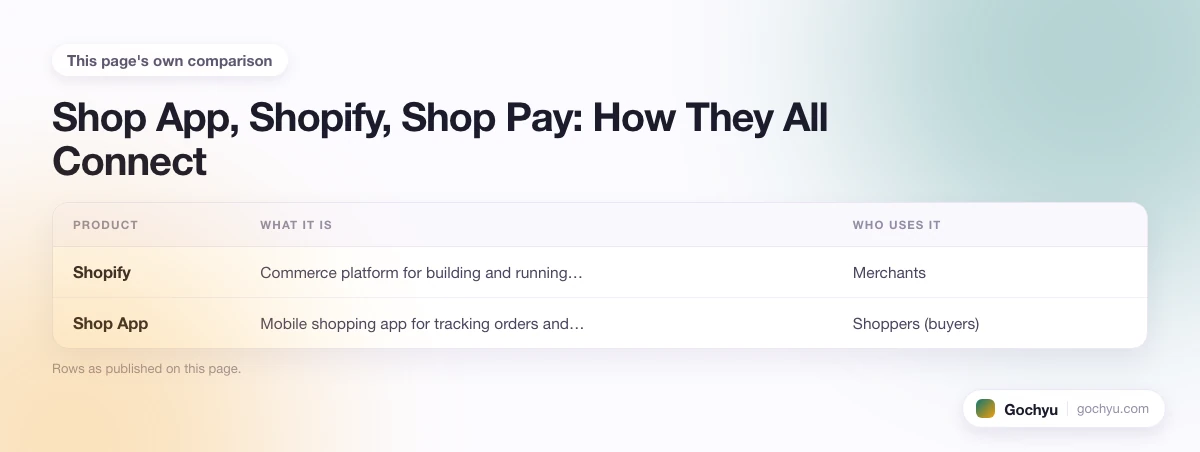
Shop App, Shopify, Shop Pay: How They All Connect
The three names cause genuine confusion because they share branding, infrastructure, and a parent company. Here is a plain breakdown:
| Product | What it is | Who uses it | Owned by |
|---|---|---|---|
| Shopify | Commerce platform for building and running online stores | Merchants | Shopify Inc. (NYSE: SHOP) |
| Shop App | Mobile shopping app for tracking orders and discovering products | Shoppers (buyers) | Shopify Inc. |
| Shop Pay | Accelerated checkout method that saves payment and shipping details | Shoppers at checkout | Shopify Inc. |
All three are owned and operated by the same company, Shopify Inc. None of them are independent businesses, subsidiaries, or third-party apps that Shopify acquired and operates separately. They are all built in-house. The parent company, the technology infrastructure, and the ownership are the same. What differs is the user, the purpose, and the interface.
If someone asks "who owns the Shop App," the answer is Shopify Inc. If they ask "who owns Shop Pay," the answer is also Shopify Inc. If they ask "who owns Shopify" or "what is Shopify's parent company," the answer is that Shopify Inc. is itself a publicly traded company (NYSE: SHOP) where Tobi Lutke, the founder, still controls roughly 40% of voting power through supervoting shares, with the rest distributed among institutional investors and public shareholders. Shopify does not have a parent company. It operates independently as a public company.
Why Does Shopify Own the Shop App?
Shop App deepens Shopify's ecosystem by creating a direct relationship with consumers, not just merchants. Most e-commerce platforms are B2B tools that never interact with the end buyer. Shop App gives Shopify a B2C touchpoint, which matters for three reasons:
- It drives repeat purchases back to Shopify-powered stores, increasing merchant revenue and Shopify's transaction fees
- It strengthens Shop Pay as a payment method that competes with Apple Pay, Google Pay, and PayPal
- It gives Shopify consumer behavior data that makes its merchant-facing tools (recommendations, marketing, analytics) more accurate
For buyers, it's a centralized hub for everything they've ordered from any Shopify store. For merchants, it's free additional distribution to an audience that's already primed to buy.
For a full breakdown of what Shop App does for Shopify merchants, including how the discovery algorithm works, how to enable it, and whether you can opt out, see our dedicated guide.
* read the rest of the post and open up an offer