
Shopify and Wix both let you build an online store, but they were not built for the same job. Shopify is a dedicated ecommerce engine with hundreds of payment integrations, inventory tools, and a checkout that scales from one product to a hundred thousand. Wix is a general website builder that ships with a perfectly capable store module bolted on, fine for a small catalog and a low order count but not where you want to be on Black Friday with five-figure traffic.
The short version: pick Shopify when ecommerce is the point of the site, pick Wix when the store is one part of a larger content or service site. The rest of this guide explains why, including the line-item pricing, the transaction fee math, the SEO trade-offs, and the migration cost most comparison posts skip over.
Shopify vs Wix: At a Glance
The two platforms target different buyers. Here is how they line up on the dimensions that actually matter for an online store.
- Built for: Shopify is built for ecommerce. Wix is built for general websites with ecommerce as one feature.
- Cheapest paid plan: Wix Light at $17/mo (no ecommerce). Shopify Basic at $29/mo (full ecommerce).
- Cheapest ecommerce plan: Wix Core at $29/mo. Shopify Basic at $29/mo.
- Transaction fees: Shopify charges 0% with Shopify Payments, 2% with third-party processors on Basic. Wix charges 2.9% + $0.30 on every plan regardless of processor.
- Templates: Wix has 900+ templates and unrestricted drag-and-drop. Shopify has 13 free and around 240 paid themes with a section-based editor.
- App ecosystem: Shopify App Store has 8,000+ apps. Wix App Market has around 500 apps.
- Product limit: Shopify scales to hundreds of thousands of SKUs without performance trouble. Wix Stores starts to feel sluggish past a few thousand.
- Multi-channel selling: Shopify connects to Amazon, eBay, TikTok Shop, Instagram, and Facebook with native sync. Wix supports Facebook, Instagram, and Amazon but with weaker inventory sync.
- POS: Shopify POS runs on iOS and Android with dedicated hardware and unlimited staff accounts on Retail or Advanced. Wix has a basic POS through Square integration.
- Best for: Wix is best for service businesses, portfolios, blogs, and small product catalogs under 100 SKUs. Shopify is best for serious ecommerce and any store planning to grow past five figures a year.
Pricing: What You Actually Pay Each Month
The headline prices look similar, but the math diverges fast once you factor in transaction fees, payment processing, and the add-ons each platform charges for. Here is the real breakdown.
Shopify Plans (as of 2026)
- Basic ($29/mo yearly, $39/mo monthly). 2% transaction fee on third-party processors, 0% on Shopify Payments. Unlimited products. 2 staff accounts.
- Shopify ($79/mo). 1% third-party fee, 0% on Shopify Payments. Better shipping discounts. 5 staff accounts.
- Advanced ($299/mo). 0.5% third-party fee. Custom reports. 15 staff accounts.
- Plus (from $2,300/mo). Enterprise tier with custom checkout and unlimited staff.
The full breakdown of every Shopify plan, including the hidden costs and app fees most reviewers miss, is in our complete Shopify pricing guide.
Wix Plans (as of 2026)
- Light ($17/mo). No ecommerce. Personal sites only.
- Core ($29/mo). Basic ecommerce. 50 GB storage. Wix Stores enabled.
- Business ($36/mo). Standard ecommerce. 100 GB storage. Subscriptions and multi-currency.
- Business Elite ($159/mo). Unlimited storage, advanced shipping, dropshipping with Modalyst.
For the deeper Wix cost analysis including the hidden charges around premium apps and email marketing, see our Wix pricing breakdown.
The Real Cost Comparison
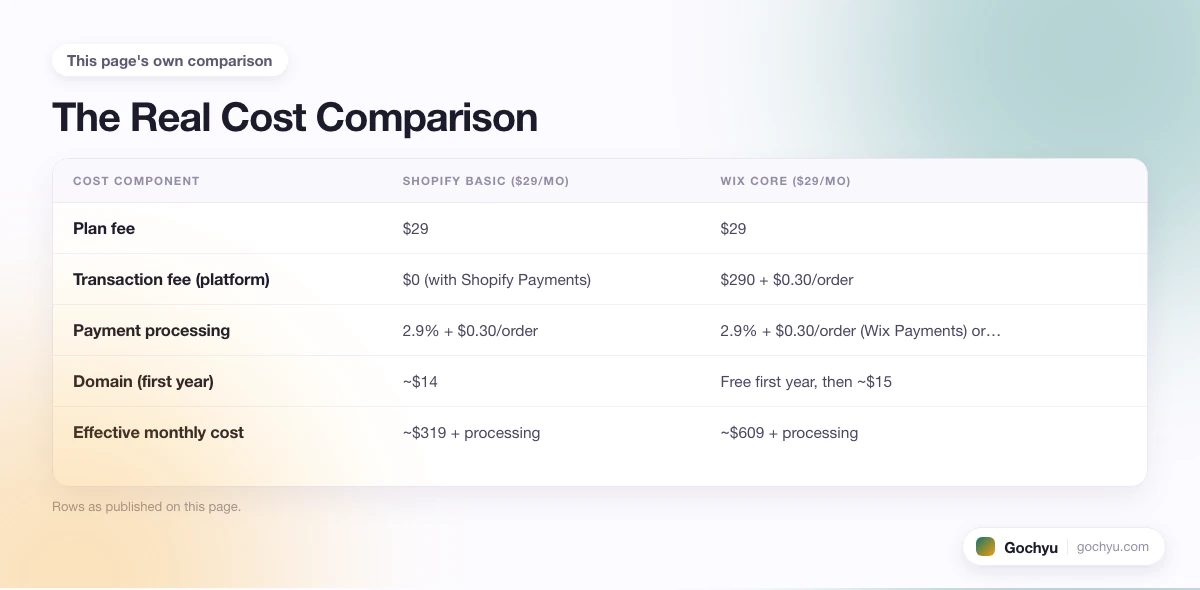
If you process $10,000 a month in sales on the entry ecommerce plan, here is what each platform actually costs.
| Cost component | Shopify Basic ($29/mo) | Wix Core ($29/mo) |
|---|---|---|
| Plan fee | $29 | $29 |
| Transaction fee (platform) | $0 (with Shopify Payments) | $290 + $0.30/order |
| Payment processing | 2.9% + $0.30/order | 2.9% + $0.30/order (Wix Payments) or third-party rate |
| Domain (first year) | ~$14 | Free first year, then ~$15 |
| Effective monthly cost | ~$319 + processing | ~$609 + processing |
That 2.9% Wix charges on top of payment processing is the line item most comparison posts skip. On $120,000 in annual revenue, it adds up to $3,480 a year that Shopify stores using Shopify Payments do not pay. The Wix Business Elite plan removes some of this but lifts the base to $159/mo.
Ease of Use: Drag-and-Drop vs Section-Based Editing
This is where Wix has a real, measurable advantage, and it matters more than ecommerce-first reviewers usually admit. Wix's editor is a true drag-and-drop canvas: click anywhere on the page, move any element by any number of pixels, layer images and text however you want. There is no other site builder with this level of visual freedom at this price.
Shopify's theme editor is section-based instead. You choose a theme, then add or rearrange pre-built blocks (slideshow, product grid, image with text, newsletter signup) in a fixed order down the page. You cannot put an element at an arbitrary pixel coordinate. You cannot overlap two images without writing custom Liquid code.
For most stores this restriction is a feature, not a bug. Section-based editing keeps pages mobile-responsive automatically, which Wix's pixel-positioning does not (Wix gives you a separate mobile editor you have to maintain). It also produces faster, lighter pages because the components are pre-optimized. But if you want a homepage that looks like a magazine cover or a product page with a hero video that spills over the navigation, Wix lets you do it in 20 minutes and Shopify makes you hire a developer.
A practical test: if you can describe the look you want with words like "two product images side by side, with a heading above and a button below," Shopify will handle it natively. If you describe it with words like "the image overlaps the headline, and there's a decorative shape behind both," you want Wix.
Ecommerce Features: Where the Gap Is Real
Both platforms sell things, but the depth of the ecommerce toolset is not close. This is the section where the answer to "which is better" stops being "it depends" and starts being "Shopify, unless you have a specific reason."
Checkout Conversion
Shopify's checkout is one of the most-tested ecommerce checkouts in the world, with billions of dollars in conversion data behind it. Shop Pay accelerated checkout (a one-tap pay option that pulls saved cards, shipping addresses, and contact info from a shared network) lifts conversion by 9% to 18% on stores that turn it on, according to Shopify's own data, and works whether the customer has shopped at that specific store before or not. Wix has no equivalent. Its checkout is functional but generic, and there is no shared cross-store payment network behind it.
Inventory and Catalog
Shopify handles serious catalog complexity: variants, locations, automated collections by tag or vendor or price, multi-location inventory, transfers between warehouses. Wix Stores can do variants and basic categories but does not handle multi-location inventory at all on plans below Business Elite, and its filtering options for shoppers are weaker (no faceted search out of the box).
Multi-Channel Selling
If you plan to sell on Amazon, eBay, TikTok Shop, or Instagram in addition to your own site, Shopify treats this as a core use case. Native sales channel apps push your product catalog to each marketplace, pull orders back into one dashboard, and keep stock counts synced automatically. Wix supports Facebook, Instagram, and (via a third-party connector) Amazon, but the inventory sync is one-way in some directions and prone to overselling during traffic spikes.
Apps and Extensibility
Shopify's App Store has more than 8,000 apps covering everything from subscription billing to print-on-demand to bundled discounts. Wix's App Market has around 500 apps. For most common needs the gap does not matter (both have email marketing, abandoned cart, reviews, upsells). For specialized cases like B2B wholesale pricing, ERP integrations, or a custom subscription box, Shopify has multiple options and Wix has none.
A practical tell: search the Shopify App Store and Wix App Market for any niche category your store needs. If Shopify has 20 options and Wix has zero, that is the answer.
SEO: Both Are Better Than Their Reputations
The old story was that Shopify has clean URLs and Wix has SEO-killing iframes. That is no longer true on either side. Both platforms now produce clean, crawlable HTML, server-side rendered, with proper title tags, meta descriptions, canonical URLs, and editable robots.txt. Both have SSL by default. Both produce automatic XML sitemaps.
Where they differ:
- URL structure. Shopify forces product URLs into the format
/products/[slug]and collection URLs into/collections/[slug]. You cannot remove the prefix without using a redirect app. Wix lets you set arbitrary URL paths, which is slightly more flexible but rarely material for ranking. - Page speed. Shopify themes are generally faster out of the box because they ship pre-optimized for ecommerce performance. Wix sites can be made fast but require attention to which Wix apps you load (some are heavy).
- Markup. Shopify themes ship with product schema, breadcrumb schema, and review schema by default. Wix supports schema but requires you to enable it per content type in the SEO settings panel.
- Blog SEO. Wix's blog module is genuinely good for content-heavy sites. Shopify's built-in blog is functional but lightweight, and most serious content marketers running on Shopify proxy a separate blog via a subdomain or use a headless CMS.
The net: if SEO is your primary acquisition channel and you sell products, Shopify has a slight edge on ecommerce schema and speed. If your site is mostly blog content with some products, Wix's content tooling is the better fit.
Templates and Themes
Wix has roughly 900 templates organized by industry, all free with a Wix subscription, and you can customize any of them without restriction. The breadth is unmatched, no other website builder ships this many starting points. You can see the depth of the Wix template library in our roundup of the 10 best Wix templates, which highlights the strongest options for blogs and service sites. For store-first builds, our dedicated Wix eCommerce templates guide covers the 10 best options by niche.
Shopify has 13 free themes and about 240 paid themes ($150 to $400 one-time), all hand-built for ecommerce. The total count is smaller, but the floor on Shopify themes is higher: even the free ones are designed for product browsing, cart flow, and checkout conversion. If you want to see what a particular Shopify store is running, our free Theme Detector identifies the theme and any installed apps in a few seconds. If you want to confirm whether a site is built on Wix at all, use our Wix detector for an instant answer.
One more practical difference: Shopify themes are locked to Shopify, but they look great on Shopify. Wix templates are locked to Wix and look fine on Wix but cannot be exported. Once you pick a platform, the template is part of the lock-in.
Best For: Who Should Pick Which
Wix is best for
- Service businesses (consultants, contractors, salons) where the website is mainly informational and ecommerce is a small piece (booking, gift cards, a few digital products).
- Portfolio sites for photographers, designers, and creatives who need visual freedom in the editor more than they need conversion tooling.
- Content-first sites with a strong blog and a small product line, where most traffic is editorial.
- Small product catalogs under 100 SKUs with under $50,000 in annual revenue, where the transaction fee impact stays small.
- Founders who want zero learning curve and will not hire a developer.
Shopify is best for
- Dedicated stores where 80%+ of traffic is shopping or browsing products.
- Growing brands that expect to cross $100,000 in revenue within 18 months and want the platform to scale with them.
- Multi-channel sellers who need a single source of truth across their site, Amazon, Instagram, and physical retail.
- Stores with large catalogs (500+ SKUs, multiple variants, multi-location inventory).
- Founders who plan to use apps heavily for subscriptions, upsells, loyalty, or international expansion. If you ever expect to need tools to detect what apps competing stores use, you are already thinking about the kind of growth Shopify supports.
For international selling specifically, Shopify's multi-currency checkout through Shopify Markets lets customers pay in their local currency, not just see converted prices. If you're planning to sell across currencies, our guide on how to change currency in Shopify walks through setup, common mistakes, and which payment gateway you need to make it work.
The Migration Cost Most Comparisons Skip
Pick the wrong platform now and switching later is not free. This is the single most overlooked factor in Shopify vs Wix comparisons.
Moving from Wix to Shopify typically costs $500 to $3,000 in agency fees plus 20 to 60 hours of your own time for a small store. You will lose your URL structure (which means lost SEO equity unless you set up perfect redirects), your design (Wix templates do not transfer), your customer reviews on most third-party review apps, and any custom-built page layouts. Order history can be exported as a CSV but does not import cleanly into Shopify's customer profiles.
Moving from Shopify to Wix is rarer but similarly expensive. Most Shopify stores that grow past Wix's ceiling do not go back.
The practical implication: if you are 70% confident you will be doing serious ecommerce within two years, start on Shopify. The first six months on Wix saves a small amount of cash and costs a large amount of pain later. If you are 70% confident the site is and will remain mostly content, services, or hobby-level sales, start on Wix.
Common Questions Quick-Hit
A few cases where the choice gets tighter:
- Subscription box business. Shopify. The subscription app ecosystem (Recharge, Bold, Skio) is years ahead of Wix's options.
- Print-on-demand drop shipper. Shopify. Native Printful, Printify, and Gelato integrations are tighter, and order routing is more reliable at volume.
- Restaurant with online ordering. Wix. The Wix Restaurants module is purpose-built and cheaper than Shopify plus a restaurant app.
- Photographer selling prints. Wix. Visual freedom matters more than checkout sophistication for low-volume creative sales.
- Course creator selling digital products. Either, but Wix is slightly cheaper for fewer than 50 courses; Shopify is better past that.
- Local service business with no products. Wix. Shopify is overkill if the site is mostly a contact form and a portfolio.
Verdict: Which Should You Choose?
If you are building a real online store, choose Shopify. The checkout conversion, the app ecosystem, the multi-channel selling, the catalog depth, and the absence of platform transaction fees on Shopify Payments all matter more than the editor flexibility you would give up. The price difference at small volumes is real but small, and the migration cost of switching later is much larger than the savings of starting on Wix.
If you are building a content site, a service site, or a portfolio that happens to also sell a small number of things, choose Wix. The visual editor freedom is genuine, the templates are deep, and the platform is not asking you to pay for ecommerce features you will not use. If your goal is affiliate marketing specifically, see our breakdown of the best Wix templates for affiliate marketing - it covers which templates work for blog, store, and deal-aggregator models plus the top apps for tracking commissions.
If you are leaning Shopify, the next step is the step-by-step Shopify store setup guide or starting a free Shopify trial to test the editor before you commit. If you are leaning Wix, explore the Wix builder and try one of the templates from our best Wix templates roundup.
Conclusion: Shopify vs Wix
Both platforms work. The question is what you are building, not which one is "better" in the abstract. Shopify wins for ecommerce stores that plan to grow. Wix wins for content sites, service businesses, and small catalogs where the visual editor matters more than the checkout. If you are still deciding between just two platforms and want to see how Shopify and Wix compare against the full field, our ecommerce website builder comparison covers five platforms side by side with pricing and transaction fees. If you are still picking your stack, browse the best Wix templates for a feel of what Wix can do, and try the free Theme Detector to inspect any Shopify or Wix store you see in the wild so you can model your own build after what already works. For a framework that goes beyond one comparison and walks through how to evaluate every major platform, see our guide on how to choose the right ecommerce platform for your business.
* read the rest of the post and open up an offer